
Introduction: The Perpetual Rhythm of Dalal Street
In the historic labyrinth of Mumbai’s Fort precinct stands the Phiroze Jeejeebhoy Towers, the landmark headquarters of the Bombay Stock Exchange (BSE). Every single morning at 9:15 AM Indian Standard Time, millions of screens across Tier-1 metropolitan hubs, Tier-2 industrial towns, and remote rural districts flicker to life as the opening bell echoes across the National Stock Exchange (NSE) and BSE. For generations of Indian retail investors, this daily oscillation of green and red numbers represents something far deeper than dry numerical output: it represents aspirations for generational wealth, retirement security, funding children's higher education, and financial freedom.
Yet, financial markets never traverse in a straight upward trajectory. The story of Indian capitalism is a dramatic chronicle of cyclical extremes: dizzying booms fueled by domestic capital inflows, economic liberalization, and technological modernization, followed invariably by brutal market panics, economic drawdowns, and protracted periods of collective fear. These two defining phases of financial history are universally categorized as Bull and Bear markets.
Understanding the underlying mechanics, psychological anatomy, and historical context of bull and bear markets is not merely an intellectual luxury for the modern Indian saver—it is an existential imperative. With the massive democratization of equity access powered by Aadhaar-enabled e-KYC, zero-brokerage discount applications, and widespread UPI integration, over 16 crore demat accounts now participate in Indian capital markets. However, high participation without intellectual groundedness frequently turns retail wealth into cannon fodder for institutional volatility. As the founding philosophy of Paisa Hai Toh affirms: "Samjh Bhi Honi Chahiye" (If you have money, you must also have the wisdom to preserve and grow it).
The Symbolic Origins: The Upward Horn Thrust vs The Downward Paw Swipe
The usage of the "bull" and the "bear" to depict financial momentum traces its roots back centuries before electronic ticker screens and algorithm-driven order books. While historical etymology points toward 18th-century London commodity brokers—specifically skin dealers who sold bear hides before actually capturing the animal ("to sell the bear's skin before one has caught the bear," spawning the term bearskin jobbers)—the prevailing financial metaphor rests upon the biological combat behaviors of the two beasts.
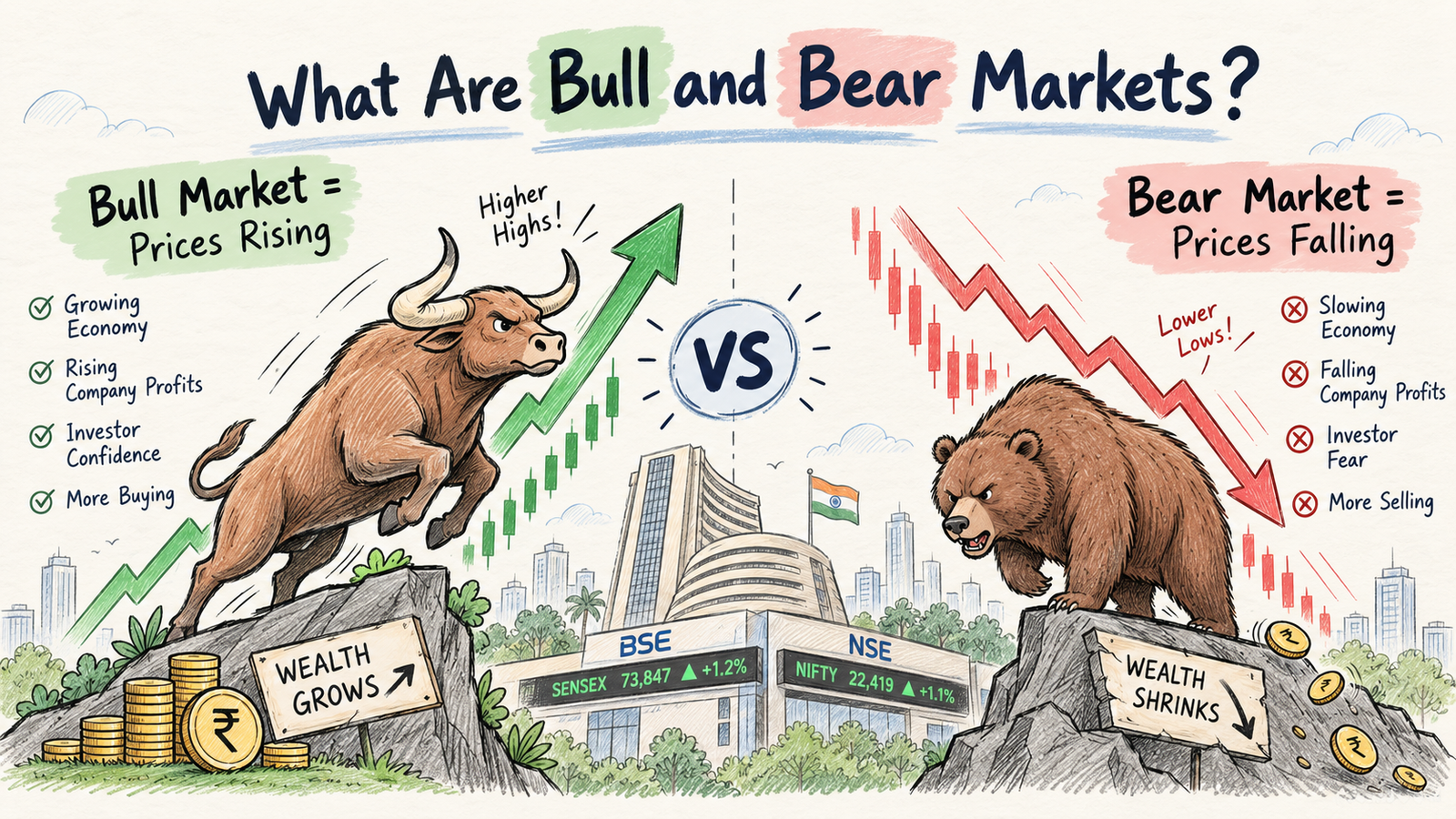
When a majestic bull engages in combat, its instinct is to lower its head and thrust its powerful horns violently upward into the sky, tossing its adversary toward the heavens. Consequently, a Bull Market denotes upward trajectory, rising corporate valuations, buoyant liquidity, and universal optimism. Investors who believe prices will climb are labeled "bullish."
Conversely, when a grizzly bear strikes, it rears upward on its hind legs and brings its razor-sharp claws swiping forcefully downward, slamming its prey into the dirt. A Bear Market therefore designates downward contraction, plummeting asset prices, pervasive gloom, and capital erosion. Those who anticipate cascading prices are characterized as "bearish."
In India, the iconic bronze charging bull erected outside the BSE rotunda remains an emblematic sanctuary of hope for domestic traders. However, seasoned market veterans understand that the bull and the bear are not mortal adversaries engaged in a zero-sum deathmatch; rather, they are complementary yin-and-yang forces necessary for cleansing systemic leverage, reallocating capital efficiently, and anchoring valuations to genuine economic reality.
Defining a Bull Market: Technical Thresholds, GDP Growth, and Investor Sentiment
While market commentary frequently uses the word "bullish" colloquially to describe a great trading week or a strong quarterly earnings report, modern quantitative finance adheres to specific structural thresholds before declaring the existence of an authentic Bull Market.
Technically, an index such as the Nifty 50 or S&P BSE Sensex enters an acknowledged bull market when it rallies by 20% or more from its previous major cyclical trough, sustained over a persistent temporal window of several months or years. However, price action alone is merely the symptomatic layer of a broader economic phenomenon. Authentic, long-duration bull markets in India are sustained by three foundational pillars:
- Robust Macroeconomic Expansion: An authentic bull market is almost always underpinned by healthy gross domestic product (GDP) expansion, declining fiscal deficits, manageable inflation, and sustained corporate earnings growth. In India, factors such as GST formalization, infrastructure capital expenditure (Capex), and steady credit growth from the banking system create the organic fuel for corporate revenues to double over multi-year cycles.
- Abundant Capital Liquidity: Whether driven by Foreign Institutional Investors (FIIs) deploying global reserve surpluses or the structural tidal wave of Domestic Institutional Investors (DIIs) fueled by over ₹20,000 Crore in monthly Systematic Investment Plan (SIP) contributions from Indian households, excess liquidity chasing finite quality equity assets naturally inflates multiples.
- Pervasive Public Optimism: During a mature bull run, consumer sentiment reaches peak optimism. Retail participants observe acquaintances compounding wealth rapidly, Initial Public Offerings (IPOs) routinely get oversubscribed by 50 to 100 times, and the mainstream media amplifies spectacular success stories while minimizing fundamental balance sheet risks.
Defining a Bear Market: 20% Drawdown Rule, Panic Selling, and Economic Headwinds
Conversely, the technical threshold for a formal Bear Market is triggered when benchmark indices (such as the Sensex or Nifty 50) collapse by 20% or more from their all-time cyclical peak. A minor decline between 5% and 10% is classified simply as a routine pullback; a descent between 10% and 20% is categorized as an intermediate market correction. But when drawdowns pierce the 20% boundary and linger for months on end, a structural bear market takes hold.
Bear markets are emotionally harrowing because asset destruction does not occur at a measured, gentlemanly pace. While bull markets climb a gentle staircase of quiet accumulation over years, bear markets jump out of an elevator shaft within weeks. The anatomy of a bear market comprises distinct, painful features:
1. Valuation Compression: High price-to-earnings (P/E) multiples collapse first, even if underlying earnings remain stable, as investors demand higher equity risk premiums.
2. Liquidity Evaporation & Margin Calls: Leveraged traders, High Net-Worth Individuals (HNIs), and proprietary desks face forced margin liquidations from brokers, causing automated sell orders that overwhelm bids.
3. Fundamental Contagion: Macroeconomic headwinds—such as spiking crude oil prices (a perennial vulnerability for the Indian Rupee), runaway consumer inflation, geopolitical skirmishes, or restrictive central bank interest rate hikes—erode corporate profit margins and paralyze capital allocation.
Major Indian Bull Runs in History: 1991, 2003-2007, and 2020-2024
The history of modern Indian equity markets offers magnificent masterclasses in wealth generation. Examining these iconic bull phases illustrates the catalyst patterns that spark domestic prosperity:
The 1991 Post-Liberalization Boom
Triggered by historic economic reforms initiated under Prime Minister P.V. Narasimha Rao and Finance Minister Dr. Manmohan Singh, India dismantled the notorious "License Raj." Private enterprise was unleashed, tariffs were slashed, and foreign institutional capital was formally welcomed. The Sensex leaped dramatically from sub-1,000 levels to breach 4,000 points within months, marking the country's psychological arrival onto the global capitalist stage.
The Golden 2003-2007 Infrastructure & Credit Supercycle
Often hailed by market veterans as the finest structural bull run in Dalal Street history. Supported by synchronous global GDP growth, the Golden Quadrilateral highway initiative, massive private power projects, and explosive IT services exports, the Sensex surged from roughly 3,000 points in early 2003 to an astounding peak of 21,206 in January 2008. Multibaggers were minted across banking, metals, real estate, and industrial manufacturing, forever changing the middle-class perception of equity investments.
The Post-Covid 2020-2024 Digital & Domestic Renaissance
Following the catastrophic March 2020 global pandemic lockdown, global central banks orchestrated historic quantitative easing. In India, a silent structural revolution took place: tens of millions of first-time retail investors joined via low-cost mobile brokers, creating a permanent domestic counterweight against foreign outflows. The Nifty 50 surged from its pandemic nadir of 7,511 points to eclipse the historic 26,000 milestone by 2024, driven by the manufacturing push (Make in India), defense indigenization, massive digital infrastructure, and unprecedented corporate balance sheet deleveraging.
Severe Indian Bear Markets and Crashes: 1992, 2008, and 2020
However, every bull run eventually pays its dues to financial gravity. Indian market history carries deep scars from catastrophic drawdowns that tested the intestinal fortitude of retail investors:
The 1992 Securities Scam Drawdown
When investigative reporting revealed that stockbroker Harshad Mehta had siphoned billions of rupees from public sector banks using fake Bank Receipts (BRs) to artificially corner blue-chip shares like ACC, the entire edifice collapsed. The Sensex plunged by over 50% from its April 1992 peak, leading directly to the establishment of statutory teeth for SEBI and the birth of modern electronic clearing at the NSE.
The 2008 Global Financial Crisis (The Lehman Collapse)
Triggered by the subprime mortgage meltdown in the United States, global liquidity froze entirely. Foreign institutional investors liquidated emerging market assets en masse to protect their domestic balance sheets. The Indian Sensex cratered from its all-time high of 21,206 down to 7,697 points—a devastating 64% peak-to-trough wipeout. Over-leveraged infrastructure and real estate conglomerates suffered permanent capital impairment, teaching investors a painful lesson regarding debt-fueled growth.
The 2020 Covid Pandemic Flash Crash
In February and March 2020, as the novel coronavirus swept across the globe and nationwide lockdowns paralyzed physical commerce, the Indian market experienced its fastest ever 40% descent. Upper and lower circuit breakers were triggered multiple times within single trading weeks. Panic selling reigned supreme as commentators predicted an indefinite global economic depression. Yet, true to historical form, this severe bear market proved to be one of the shortest in history, paving the way for the historic rally that followed.
Market Psychology and Emotions: The Cycle of Euphoria to Despair
Legendary investor Howard Marks famously noted that the financial swings of the market are driven far more by fluctuations in investor psychology than by changes in business fundamentals. The classic market cycle follows an invariant emotional pendulum:
At the absolute bottom of a bear market, Despair and Capitulation govern. Media headlines proclaim the death of equities, retail investors vow never to touch the stock market again, and stocks trade below their intrinsic book values. Then comes Relief and Hope, as astute value investors quietly accumulate undervalued gems.
As the cycle turns bullish, Optimism turns into Belief, followed rapidly by Thrill. In the final, most dangerous parabolic phase of the bull run, Euphoria takes over. Caution is branded as cowardice. Novice traders claim that "traditional valuation models are outdated in the new digital India." Taxi drivers, office colleagues, and family WhatsApp groups trade tips on micro-cap speculative stocks. This is precisely the point of maximum financial risk.
When an unexpected macro event triggers the first down-leg, the psychology shifts sequentially through Denial ("It is merely a minor dip, buy more"), to Fear, Panic, and finally back to full circle Despair. Navigating this emotional rollercoaster requires an ironclad temperament rather than an exceptional mathematical IQ.
Actionable Strategies for Retail Investors in a Bull Market
Contrary to popular intuition, retail investors frequently make their most fatal portfolio mistakes during euphoric bull markets, not bear markets. Bad habits formed during periods of effortless profits extract a devastating toll when the music stops. Here are the core disciplines to observe:
- Resist Confusing Brains with a Bull Market: When the tide is rising, almost every speculative stock rises along with high-quality blue chips. Do not mistake liquidity-driven momentum for your personal stock-picking genius. Keep speculative satellite allocations under 10% of your total net worth.
- Maintain Systematic Portfolio Rebalancing: If your intended strategic asset allocation is 70% Equities and 30% Fixed Income (such as PPF, EPF, and Debt Mutual Funds), a roaring bull run will automatically skew your portfolio to 85% equity exposure. Systematically book partial profits to restore your initial 70:30 allocation. This locks in gains and enforces the counter-cyclical rule: selling high.
- Audit Underlying Fundamentals: Avoid chasing high-P/E small caps with negligible corporate governance, pledged promoter shares, or recurring negative operating cash flows. Concentrate your core capital in market leaders boasting clean balance sheets and resilient moats.
- Never Liquidate Emergency Reserves: In the heat of greed, retail participants often empty their emergency funds or borrow money on personal loans to chase IPO allotments or short-term momentum. This is the fastest route to insolvency when sudden volatility strikes.
Actionable Strategies for Retail Investors in a Bear Market
While bull runs make you feel wealthy, bear markets are where true generational wealth is actually established. When stock prices are marked down across the board, patient savers are handed prime commercial assets at deep institutional discounts.
- Never Stop Your Mutual Fund SIPs: The cardinal sin committed by Indian retail investors during every correction is pausing or stopping their monthly Systematic Investment Plans out of fear. When the Nifty drops 20%, your fixed ₹10,000 monthly SIP purchases significantly more mutual fund units at lower Net Asset Values (NAVs). This process—known as Rupee Cost Averaging—is the mathematical engine of long-term compounding. Pausing SIPs during a bear market destroys the entire advantage.
- Deploy Staggered Lumpsum Traunches: If you possess surplus dry powder, avoid attempting to guess the precise bottom in a single aggressive gamble. Instead, deploy capital using structured tranches: allocate 25% at a 10% index drawdown, another 25% at a 15% drawdown, and the remaining 50% if the index breaches the formal 20% bear boundary.
- Focus on Dividend Aristocrats & Large-Caps: During severe panics, large institutional conglomerates with robust balance sheets, strong domestic market shares, and healthy free cash flows recover far earlier than unproven micro-caps. Prioritize Nifty 50 and Nifty Next 50 bellwethers.
- Turn Off the Sensationalist 24/7 News Cycle: Financial news channels survive on sensationalism and panic clicks. Daily volatility is merely noise; what matters for compounding is Indian economic growth over the next decade.
Why Market Timing Fails and Time in the Market Wins
The intoxicating fantasy of every novice investor is to sell their portfolio at the absolute peak of a bull market, park funds safely in bank fixed deposits, and step back in at the exact bottom of a bear market. In the real world, this strategy fails with mathematical certainty.
Extensive historical empirical data from both the NSE and BSE illustrates that a disproportionate percentage of total stock market returns are concentrated in a tiny handful of trading days throughout any decade. If an investor attempts to time the market and misses just the 10 best trading days over a 15-year holding period, their annualized portfolio return frequently plummets from 13.5% down to less than 6%—barely matching a conventional savings account.
Crucially, those "best trading days" almost always occur right in the midst of the most violent, frightening bear market crashes. Staying fully invested through uncomfortable drawdowns is the unavoidable entry price an investor pays for enjoying the astronomical rewards of equity compounding over time.
Frequently Asked Questions (FAQs)
How long do Indian bull and bear markets typically last?
Historically on Dalal Street, bull markets last considerably longer than bear markets. Over the last 40 years, an average Indian bull market has persisted for approximately 3 to 5 years, delivering extensive multi-year gains. In contrast, bear markets tend to be sharp and compressed, averaging between 9 and 18 months in duration.
What is the technical definition of a bear market correction?
In financial terms, a price decline between 10% and 20% from a recent high is defined as an intermediate correction. A full bear market is formally recognized only when the benchmark index (such as the Sensex or Nifty 50) closes 20% or more below its recent 52-week or all-time peak.
Should I stop my equity SIP when the market is crashing?
No, absolutely not. Stopping your SIP during a market crash cancels the single greatest benefit of mutual fund investing: rupee cost averaging. When the market is down, your fixed monthly investment buys a larger number of mutual fund units at discounted prices. When the market recovers, those extra units accelerate your portfolio growth exponentially.
What triggers the sudden end of an Indian bull market?
Bull markets rarely die of old age; they are typically derailed by excessive systemic leverage, aggressive central bank monetary tightening (spiking interest rates to fight inflation), geopolitical shocks, sharp spikes in Brent crude oil prices (which worsens India’s Current Account Deficit), or extreme speculative overvaluations that detach from corporate earnings.
Can retail investors profit directly from a bear market?
While derivative traders engage in short selling or buying put options, this involves immense risk of capital wipeout for retail investors. The safest, most proven way for retail investors to profit from a bear market is to aggressively accumulate high-quality blue-chip stocks and broad index mutual funds while they trade at discounted valuations, holding them for the inevitable cyclical recovery.
What is a 'Dead Cat Bounce' during a market crash?
A Dead Cat Bounce is a temporary, deceptive recovery in stock prices during an ongoing prolonged bear market. It is often caused by short-sellers closing their positions to book profits rather than genuine fundamental buying. Retail investors who jump in during a dead cat bounce often get trapped when the market resumes its downward trajectory.
How should an investor protect their capital if they need money soon?
Money required within the next 1 to 3 years (such as a home down payment, emergency medical fund, or wedding expenses) should never be exposed to equities, regardless of how strong a bull market appears. Short-term capital must always be held in safe, highly liquid instruments like High-Yield Savings Accounts, Liquid Mutual Funds, or Fixed Deposits.
Why is the Indian market considered structurally more resilient today?
Historically, Indian markets were entirely at the mercy of foreign capital (FII flows). Whenever foreigners pulled money out, Indian indices collapsed. Today, the systematic monthly domestic retail inflows via Mutual Fund SIPs (exceeding ₹20,000+ Crore every single month) provide a steady domestic counterweight that absorbs foreign selling pressure and cushions downturns.
Key Takeaways Summary
check_circle
Respect the Cyclical Nature
No bull run lasts forever, and no bear market is permanent. Both are natural, healthy phases of capital allocation.
check_circle
Rupee Cost Averaging is Sacred
Never cancel mutual fund SIPs during drawdowns. Bear markets are when you accumulate cheap units that build future wealth.
check_circle
Asset Allocation Protects Peace of Mind
Maintain a healthy split between equities and fixed-income assets. Rebalance systematically when greed takes over.
check_circle
Discipline Beats Intelligence
You do not need a finance degree to succeed. Managing your emotions when Dalal Street is bleeding will determine your real returns.