
The Great Indian Equity Dilemma: Active or Passive?
Choosing between index funds and actively managed mutual funds is an important decision for Indian investors. Both allow you to invest in a diversified portfolio of securities, but they follow different investment strategies.
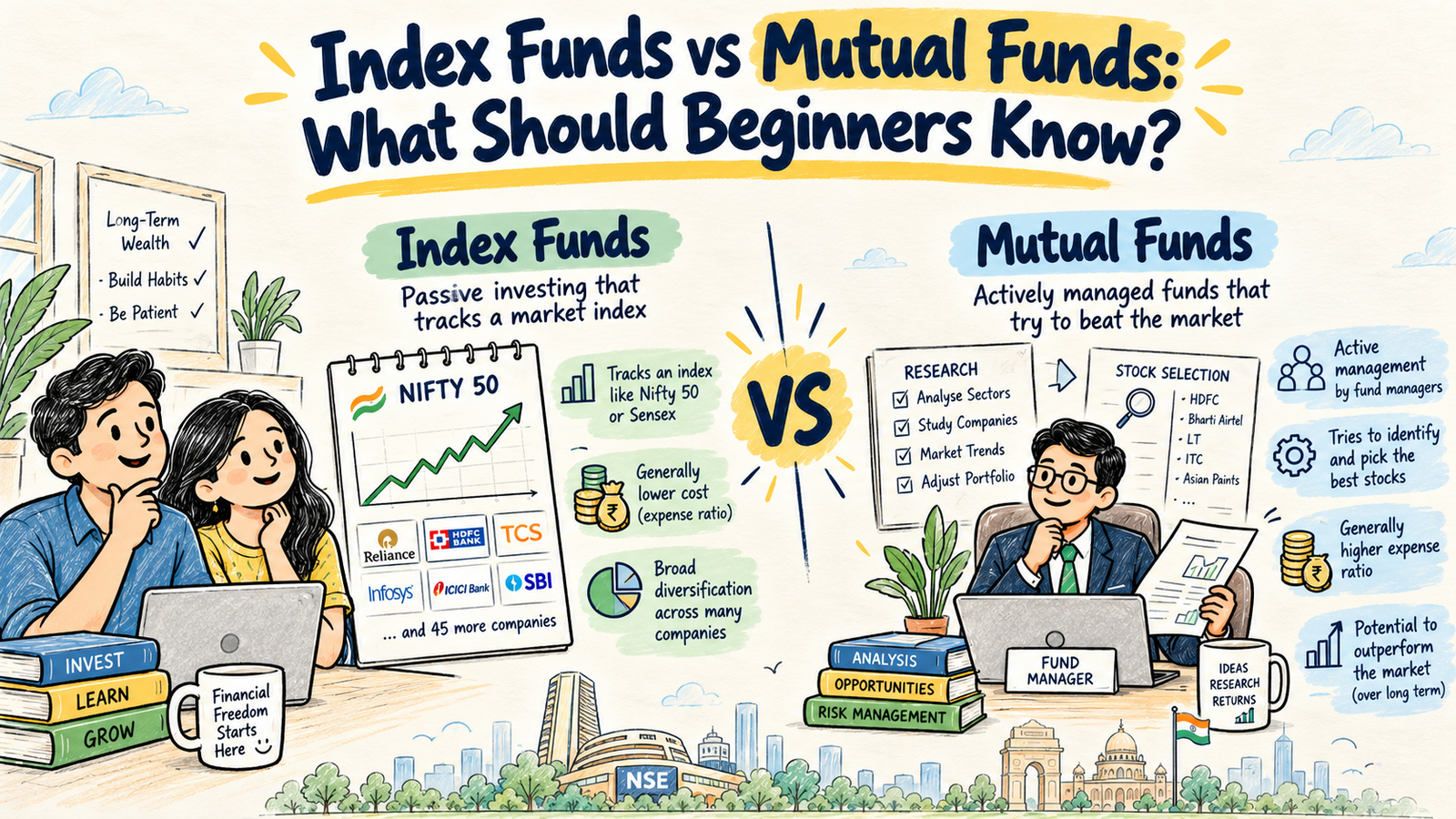
An index fund is a type of mutual fund that aims to track a market index such as the Nifty 50 or BSE Sensex. An actively managed mutual fund relies on a fund manager to select investments with the objective of outperforming a relevant benchmark.
Index funds generally have lower management costs, while actively managed funds may offer opportunities for outperformance but also carry the risk of underperforming their benchmarks.
This guide explains the differences between index funds and actively managed mutual funds in India, including their costs, returns, risks, tracking error and suitability for beginners.
Index Funds vs Active Mutual Funds: Key Differences
| Feature | Index Fund | Actively Managed Mutual Fund |
|---|---|---|
| Management style | Passive | Active |
| Investment objective | Track a selected index | Follow a strategy, often seeking benchmark outperformance |
| Stock selection | Based on index methodology | Based on fund manager decisions |
| Expense ratio | Generally lower | Generally higher |
| Portfolio changes | Mainly driven by index changes and fund flows | Driven by investment strategy and manager decisions |
| Returns | Aim to closely track the benchmark | May outperform or underperform the benchmark |
| Market risk | Present | Present |
| Key evaluation factors | TER, tracking difference, tracking error | TER, risk-adjusted returns, benchmark comparison |
The main difference between index funds and actively managed mutual funds lies in how their investments are selected. Index funds follow a benchmark-based strategy, while active funds rely on fund managers to make investment decisions.
Both are mutual funds, and both carry investment risks. Index funds generally offer lower expenses, while actively managed funds may outperform or underperform their benchmarks depending on the decisions made and prevailing market conditions.
Dissecting the Terminology: Active Mutual Funds vs Index Funds
Before analyzing returns and fee structures, it is essential to understand the philosophical and operational differences between these two vehicles.
psychology What is an Active Mutual Fund?
An actively managed mutual fund is a scheme in which a professional fund manager makes investment decisions based on the fund's objectives, research and investment strategy.
For example, an actively managed large-cap equity fund may select shares of established Indian companies and adjust its portfolio based on valuations, business performance and market conditions.
The fund manager generally aims to generate competitive returns and may seek to outperform an appropriate benchmark, although outperformance is not guaranteed.
Active management involves research and portfolio decisions that can result in higher expenses than many passive index funds. Actual costs vary by scheme and plan.
smart_toy What is an Index Fund?
An index fund is a passively managed mutual fund that aims to replicate or track the performance of a selected market index, such as the Nifty 50, BSE Sensex or Nifty Next 50.
For example, a Nifty 50 index fund generally invests in the companies included in the Nifty 50, with allocations designed to closely follow the index's composition and methodology.
Unlike an actively managed fund, an index fund does not primarily attempt to select individual stocks that will outperform the market. Its objective is to track the chosen index as closely as practical.
However, an index fund's returns may differ from those of its benchmark due to expense ratios, transaction costs, cash holdings and operational factors. Index funds can also experience market losses.
For an official explanation of passive investing, refer to SEBI’s guide to index mutual funds.
The S&P SPIVA India Scorecard: What Does Hard Data Prove?
In wealth management, marketing narratives often emphasize stock-picking brilliance. However, the semi-annual S&P Indices Versus Active (SPIVA) India Scorecard provides transparent, unvarnished statistical evidence comparing Indian active funds with their corresponding benchmarks.
The S&P Indices Versus Active (SPIVA) India Scorecard evaluates the performance of actively managed Indian mutual funds against relevant benchmarks over different periods.
According to the SPIVA India Mid-Year 2026 report, the percentage of Indian Equity Large-Cap funds that underperformed their relevant benchmark was:
- 3 years: 53%
- 5 years: 55%
- 10 years: 82%
The benchmark used for this category was the S&P India LargeMidCap. These figures should not be interpreted as a direct comparison against the Nifty 50 index.
The results suggest that consistently outperforming a benchmark over long periods can be challenging for active fund managers. However, some active funds do outperform, and the percentage varies across market conditions, fund categories and evaluation periods.
Source: S&P SPIVA India Mid-Year 2026 Scorecard.
These performance figures are drawn from the S&P SPIVA India Mid-Year 2026 Scorecard, which compares active fund performance against relevant benchmarks.
Why Is Outperforming a Benchmark Difficult for Active Fund Managers?
Several factors can make benchmark outperformance challenging for actively managed equity funds.
- Investment Restrictions and Fund Categories: SEBI’s mutual fund categorisation framework establishes investment requirements for different fund categories. These requirements help maintain consistency between a fund’s stated category and its portfolio, while also limiting how far managers can deviate from their investment mandate.
- Competition and Information Availability: Large Indian companies are closely followed by institutional investors, analysts and other market participants. Extensive research and competition can make it difficult to identify opportunities that are not already reflected in market prices.
- Total Return Benchmarking: Mutual fund performance comparisons increasingly use Total Return Indices (TRI), which account for dividend income as well as price movements. This provides a more comprehensive basis for evaluating performance against an index.
These factors help explain why active funds can struggle to outperform consistently, but they do not establish that active management can never succeed.
Active vs Passive Across Market Capitalizations
Does the underperformance of active large-cap funds mean Indian investors should abandon all active mutual funds? Absolutely not. India remains a dynamic emerging market where market efficiency varies dramatically across capitalization tiers:
Large-Cap Funds: Active vs Passive Performance
Large-cap companies are widely researched and actively traded, making consistent benchmark outperformance challenging for many active fund managers.
Low-cost index funds provide a straightforward way to gain exposure to a large-cap index without relying on individual stock-selection decisions. Their lower expense ratios can be an advantage over time.
However, not every actively managed large-cap fund underperforms its benchmark, and index funds do not guarantee better returns. Investors should compare long-term performance, costs, portfolio characteristics and risk before making a choice.
Mid-Cap and Small-Cap Funds: Opportunities and Risks
Mid-cap and small-cap companies may receive less analyst coverage than India's largest listed businesses. This can create opportunities for skilled active fund managers to identify companies with attractive valuations or long-term business prospects.
However, smaller companies may also carry higher volatility, liquidity risk and business uncertainty.
Active fund managers can attempt to manage these risks through research and portfolio selection, but they can still underperform relevant benchmarks.
The SPIVA India Mid-Year 2026 report found that 79% of Indian Equity Mid-/Small-Cap funds underperformed their relevant benchmark over the preceding ten years. However, results differed substantially across shorter periods.
Investors should compare active and passive options within the same market-cap category rather than assuming that active small-cap management will consistently generate superior returns.
Expense Ratio: The Mathematical Advantage of Passive Investing
The Total Expense Ratio (TER) represents the annual percentage deducted from a fund's Net Asset Value (NAV) to cover management fees, custodial charges, administrative overhead, and marketing expenses. While 1% might sound insignificant over a twelve-month span, the compounding friction over a 15 to 25-year investment horizon can erode a substantial portion of your ultimate corpus.
How Expense Ratios Affect Long-Term Investment Returns
The Total Expense Ratio (TER) represents the ongoing costs incurred by a mutual fund scheme. These expenses are reflected in its Net Asset Value (NAV) and can reduce investors' net returns.
Index funds generally have lower expense ratios than actively managed funds, although actual costs vary by scheme and between Direct and Regular Plans.
Consider a hypothetical investor making a ₹15,000 monthly SIP for 20 years.
Assume both funds earn an identical gross annual return of 12% before expenses. For this simplified example:
- Index Fund TER: 0.15% annually
- Active Fund TER: 1.15% annually
- Assumed Index Fund Net Return: 11.85% annually
- Assumed Active Fund Net Return: 10.85% annually
Using monthly compounding with annual net rates divided by 12 and contributions at the end of every month:
- Total Invested: ₹36 lakh
- Estimated Index Fund Value: ₹1.45 crore
- Estimated Active Fund Value: ₹1.27 crore
- Illustrative Difference: Approximately ₹17.13 lakh
Apart from choosing between active and passive mutual funds, investors should also understand the difference between Direct and Regular Plans. Read our guide on Direct vs Regular Mutual Funds to learn how expense ratios and distributor-related costs affect investment returns.
This example demonstrates how a 1 percentage point difference in assumed annual net returns can influence long-term investment growth.
However, actual active and index funds will not necessarily generate identical gross returns. An active fund may outperform or underperform its benchmark, and expense ratios can change.
Important: These are hypothetical mathematical projections, not actual fund performance or guaranteed future returns. The calculation simplifies the effect of expenses and excludes taxes and other investor-specific costs.
Investors can check current scheme-wise expense ratios using AMFI’s official Total Expense Ratio disclosures.
Current scheme-wise expenses can be checked through AMFI’s Total Expense Ratio disclosures.
The Nuances of Index Investing: Tracking Error & Tracking Difference
While index funds eliminate managerial stock-picking risk, beginner investors often mistakenly assume that an index fund's return will be 100% identical to the Nifty 50 or Sensex index. In practice, real-world operational factors introduce subtle divergences known as Tracking Difference and Tracking Error.
An index fund’s performance is reflected in changes to its Net Asset Value (NAV). If you’re unfamiliar with how NAV works, read our beginner’s guide on What Is NAV in Mutual Funds and Why Does It Matter?
Tracking Difference (TD)
Tracking difference measures the difference between an index fund's return and the return of its benchmark index over a specified period.
Tracking Difference = Fund Return − Benchmark Return
For example, if a Nifty 50 index fund delivers an annual return of 11.7% while its benchmark Total Return Index delivers 12%, the tracking difference is −0.3 percentage points.
A negative tracking difference can arise from fund expenses, cash holdings, transaction costs and other operational factors. It should not be assumed to remain at a fixed percentage every year.
To understand how closely index funds track their benchmarks, refer to SEBI’s guide to tracking error.
Tracking Error (TE)
Tracking error measures how consistently a fund's returns follow its benchmark over time. It is generally calculated using the variability of periodic return differences.
A lower tracking error indicates that the fund has followed its benchmark more consistently during the measurement period. However, low tracking error alone does not guarantee superior investment returns.
Why Do Deviations Occur in Indian Index Funds?
- Fund Expenses: Management and operating expenses reduce the returns reflected in the fund’s NAV.
- Cash Holdings and Investor Flows: Cash maintained for subscriptions and redemptions may cause temporary differences from the benchmark.
- Index Rebalancing and Transaction Costs: Buying and selling securities following changes in index composition can create additional costs.
- Dividends and Corporate Actions: Differences in the timing and treatment of corporate actions may affect short-term tracking.
When evaluating index funds, compare tracking difference, tracking error, expense ratios and the fund's investment objective rather than relying on one metric alone.
Index Mutual Funds vs Exchange Traded Funds (ETFs): Which is Better for Beginners?
When pursuing passive investing in India, you have two primary vehicles: an Index Mutual Fund (such as the UTI Nifty 50 Index Fund or Navi Nifty 50 Index Fund) and an Exchange Traded Fund (such as Nippon India ETF Nifty 50 BeES or SBI Nifty 50 ETF). While both mirror the same underlying index, their mechanics differ substantially:
Index Mutual Funds: Key Features
- No Demat Account Required for Normal Mutual Fund Holdings: Investors can generally purchase and hold index mutual funds outside Demat form through authorised mutual fund channels.
- SIP Facility: Many index mutual funds allow regular investments through SIPs, subject to their minimum amounts and operational requirements.
Index mutual funds can also be purchased through regular SIP investments. If you’re new to systematic investing, explore our guide on What Is SIP and How Does It Work in India? to understand monthly investments, rupee cost averaging and investment risks.
- NAV-Based Transactions: Units are normally allotted or redeemed at the applicable NAV determined under the relevant cut-off and fund-realisation rules. Same-day NAV is not automatically guaranteed.
- Ease of Investing: Index mutual funds may be convenient for investors who prefer regular contributions without placing stock-exchange orders.
Exchange-Traded Funds (ETFs): Key Features
- Exchange Trading: ETFs are bought and sold on stock exchanges during market hours.
- Market Prices: ETF transaction prices depend on available buyers and sellers and can differ from their indicative NAV.
- Costs: Some ETFs have low expense ratios, but investors should also consider brokerage, bid-ask spreads and other applicable trading costs.
- Liquidity: Trading volumes and spreads vary considerably across ETFs.
Both index mutual funds and ETFs can provide passive investment exposure. The appropriate choice depends on the investor's preferred transaction method, costs, liquidity requirements and familiarity with exchange trading.
Can Investors Combine Index Funds and Active Mutual Funds?
Some investors choose to combine index funds and actively managed mutual funds within a broader investment portfolio. This is sometimes called a core-and-satellite approach.
After selecting a suitable mutual fund, investors must also decide how to contribute their money. Our comparison of SIP vs Lump Sum Investment explains how regular and one-time investments differ in timing, market exposure and risk.
Core Investments
The core portion may include diversified, low-cost investment funds selected according to the investor's financial goals, risk tolerance and investment horizon.
For example, a broad-market index fund can provide exposure to many companies through a single scheme. However, even diversified equity index funds remain exposed to stock-market declines.
Satellite Investments
A satellite portion may include actively managed funds or specialised investment strategies intended to provide different market exposures.
These investments may introduce additional risks, especially when they concentrate on mid-cap, small-cap, sectoral or thematic stocks.
Is a Core-and-Satellite Strategy Suitable for Beginners?
There is no universal portfolio allocation suitable for every investor. The appropriate mix depends on factors such as income stability, emergency savings, investment horizon, existing assets and tolerance for financial losses.
Investors should also consider their overall allocation across equity, debt and other appropriate assets rather than concentrating only on different types of equity mutual funds.
A core-and-satellite structure does not guarantee higher returns, prevent losses or eliminate the risks of active fund management.
This balanced architecture guarantees that the bulk of your wealth is protected against managerial underperformance and excessive fees, while retaining exposure to the dynamic entrepreneurial vitality of India's broader economy.
Frequently Asked Questions (FAQ) for Indian Retail Investors
Can index funds lose money during a stock market crash?
Yes. Index funds are exposed to the risks of their underlying investments. If the tracked index falls sharply, an index fund tracking that benchmark will generally experience a similar decline, subject to tracking differences. Passive management does not protect investors from market crashes, and losses can occur even over longer investment periods.
How do dividends work in an Indian index fund?
When companies held by an equity index fund pay dividends, the fund receives the income according to the relevant corporate-action rules. The income forms part of the fund's assets and is reflected in its NAV, subject to expenses and other factors.
Investors may be offered Growth and Income Distribution cum Capital Withdrawal (IDCW) options, depending on the scheme. Under the Growth option, returns remain reflected in the investment value. IDCW distributions, when declared, are subject to applicable tax rules and are not guaranteed.
Index fund performance should generally be compared against an appropriate Total Return Index that includes dividend effects.
How do I identify an index fund with the lowest tracking error?
Review the fund's official factsheet and the tracking error and tracking difference disclosures available through its AMC or AMFI.
Compare funds tracking the same benchmark over consistent periods. Also consider expense ratios, fund size, the investment strategy and the AMC's operational record.
There is no universal rule that every index fund must have tracking error below 0.10% or assets exceeding ₹1,000 crore to be suitable. These factors should be evaluated together rather than treated as automatic selection thresholds.
Are capital gains taxes different for index funds vs active mutual funds?
Capital gains tax generally depends on the mutual fund's classification, holding period and applicable tax provisions rather than whether the fund is actively or passively managed.
For qualifying equity-oriented mutual fund units, short-term capital gains covered by Section 111A are generally taxed at 20%, plus applicable surcharge and cess. Long-term capital gains covered by Section 112A exceeding an aggregate ₹1.25 lakh in a financial year are generally taxed at 12.5%, plus applicable surcharge and cess, subject to statutory conditions.
Different rules can apply to debt, international and other fund categories. Investors should verify the latest tax provisions before redeeming investments.
Is Nifty 50 better or BSE Sensex better for a beginner?
Both the Nifty 50 and BSE Sensex are widely followed Indian equity benchmarks. The Nifty 50 includes 50 companies, while the Sensex includes 30 companies.
Their performance often moves in similar directions because they share several large constituents, but their sector weights, index composition and returns are not identical.
Beginners should compare the available index funds' expenses, tracking performance, diversification and investment objectives rather than assuming one benchmark is always superior.
What is the Nifty Next 50 index fund, and is it riskier?
A Nifty Next 50 index fund aims to track the Nifty Next 50 index, which represents 50 companies selected from the Nifty 100 after excluding the Nifty 50 constituents.
Its composition differs from the Nifty 50, and it may experience substantial volatility and market declines. It should not automatically be considered a safer alternative or a guaranteed higher-growth investment.
Investors should review the fund's Riskometer, index methodology and historical risk characteristics before investing.
Can I invest in an index fund without a Demat account?
Yes, absolutely. Index Mutual Funds (unlike ETFs) do not require a Demat or trading account. You can transact directly through AMC mobile apps, Registrar and Transfer Agents (CAMS and KFintech), or official platforms like MFCentral.
Should I stop my existing active mutual fund SIPs immediately?
Not necessarily. Before stopping or changing an existing SIP, evaluate the fund's performance against an appropriate benchmark over consistent periods, along with its expenses, risks, investment strategy and suitability for your goals.
A period of underperformance does not automatically mean that switching to an index fund is the right decision. Consider any applicable exit loads or capital gains taxes before redeeming existing units.
Investors who need personalised recommendations can consult a suitably qualified, SEBI-registered investment adviser.
Key Takeaways: Index Funds vs Active Mutual Funds
check_circle
Index funds are mutual funds
They aim to track a selected benchmark rather than consistently outperform it.
check_circle
Active funds rely on investment decisions
Fund managers select securities with the objective of meeting the scheme's strategy and potentially outperforming a relevant benchmark.
check_circle
Costs matter
Index funds generally have lower expense ratios, which can benefit long-term returns when other factors are comparable.
check_circle
Outperformance is uncertain
Some actively managed funds outperform benchmarks, but many struggle to do so consistently over long periods.
check_circle
Risk remains
Both active equity funds and equity index funds can lose money during market downturns.
check_circle
Suitability comes first
Investors should compare fund objectives, risk, expenses, tracking performance and their own financial circumstances before choosing.
Official Sources and References
This guide draws on publicly available information from Indian financial regulators, mutual fund industry resources and investment research.
- SEBI – Understanding Index Mutual Funds – How index funds work, passive investing and benchmark tracking.
- AMFI – Types of Mutual Fund Schemes – Active and passive investment strategies and mutual fund categories.
- AMFI – Total Expense Ratio Disclosures – Scheme-wise expense ratio information.
- S&P SPIVA India Mid-Year 2026 – Research comparing actively managed mutual funds against relevant market benchmarks.
- SEBI – Understanding Tracking Error – Tracking error and benchmark performance differences.
- SEBI – Understanding the Riskometer – Mutual fund risk classification.
- Income Tax Department – Capital Gains – Applicable capital gains taxation guidance.
Readers should refer to the latest official publications because market conditions, regulations, taxation and fund expenses may change.
Ready to continue your wealth education?
Explore our step-by-step guides on SIP compounding, emergency funds, and direct tax optimization.
Investment Risk Disclaimer
This article is intended for general financial education and does not constitute personalised investment, financial or tax advice.
Mutual fund investments are subject to market risks. Neither index funds nor actively managed mutual funds guarantee returns or protect investors against financial losses.
Past performance does not guarantee future results. Investors should review each fund's investment objectives, risk classification, expense ratio and official scheme documents before making investment decisions.
Paisa Hai Toh does not claim endorsement or approval from SEBI or AMFI. Investors who require personalised advice should consult an appropriately qualified professional.