
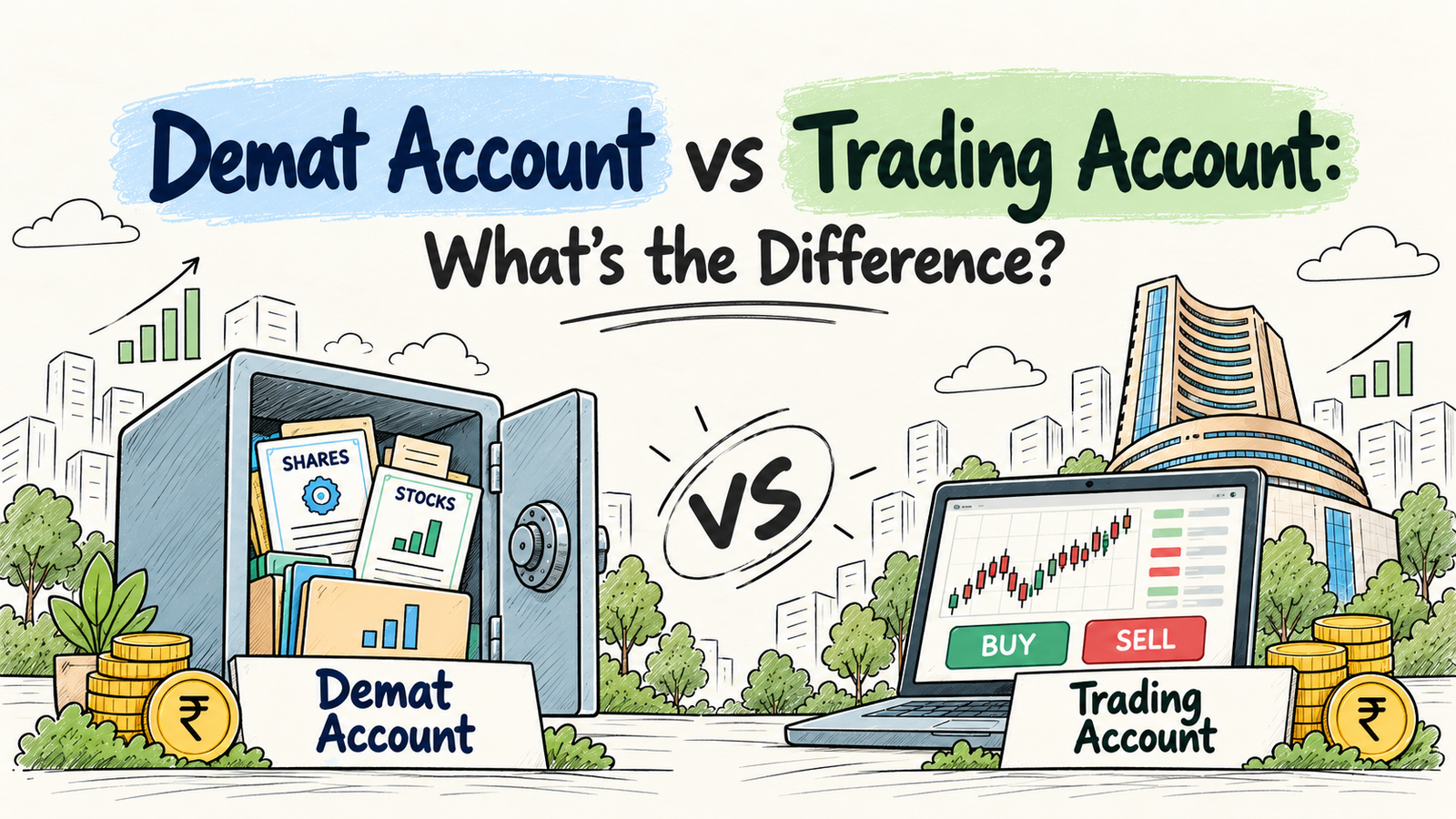
Introduction: Demystifying the Two Accounts Every Investor Needs
When entering the Indian equity market for the very first time, almost every beginner encounters a universal phrase from registered stockbrokers: "Open your Demat and Trading Account in under five minutes." Because these two accounts are almost universally marketed and provisioned together as an integrated bundle, an overwhelming majority of retail investors believe they are identical entities or synonyms for the same digital bucket.
However, conflating a Demat account with a Trading account is fundamentally inaccurate. In the regulated financial architecture structured by the Securities and Exchange Board of India (SEBI), these two accounts execute entirely separate functions, report to different regulatory custodians, and follow distinct fee models. Failing to comprehend this separation causes unnecessary confusion regarding Account Maintenance Charges (AMC), Brokerage vs. Depository Participant (DP) charges, off-market stock transfers, pledge mechanics, and dividend distribution channels.
Whether you intend to invest ₹500 per month through equity SIPs or actively manage a diversified long-term portfolio of blue-chip shares, understanding the operational boundaries between your savings bank account, your trading interface, and your central depository vault is the essential foundation of investor competence.
The Core Analogies: The Bank Locker vs The Payment Gateway
To demystify these accounts instantly, let us look at two real-world analogies familiar to every Indian household: the relationship between a high-security bank vault and a merchant payment terminal, as well as the standard savings bank ecosystem.
Analogy 1: The Secure Vault vs The Electronic Highway
Consider your Demat Account as a secure, government-regulated electronic safety deposit locker. Once you purchase physical gold jewelry or certificates, they sit quietly inside this locker under tight surveillance. The locker does not transact with anyone on Dalal Street; it merely preserves your wealth in immutable digital custody.
In contrast, your Trading Account is the vehicle or highway you hire to visit the marketplace. It is the active buying and selling terminal—similar to an authorized courier or merchant gateway—that carries your purchase order to the exchange counter, negotiates the market price, and delivers the acquired asset to the locker doorstep.
Analogy 2: The Three-Legged Stool of Indian Investing
Every retail investor sits upon a three-legged operational stool:
1. The Bank Account: Holds your liquid cash (INR).
2. The Trading Account: Transfers money and communicates buy/sell orders to NSE or BSE.
3. The Demat Account: Stores your dematerialized shares, ETFs, Government Securities, and mutual fund units.
What Is a Demat Account? Definition, CDSL, NSDL, and Holding Securities
A Demat Account (short for Dematerialized Account) is an electronic registry where financial securities are converted from physical paper certificates into digital credits. Prior to the enactment of the Depositories Act of 1996, Indian retail investors held tangible paper stock certificates. This archaic era was plagued by severe systemic friction, including counterfeit share certificates, postal delays, bad deliveries, signature mismatches, and destruction of documents due to dampness or fire.
Under modern regulations, when you purchase a share, physical certificates are no longer printed. Instead, a digital ledger entry is permanently inscribed in your name within a Central Depository. In India, there are strictly two authorized national depositories:
- NSDL (National Securities Depository Limited): Established in 1996, primarily promoted by the National Stock Exchange (NSE), IDBI Bank, and leading national institutions. Account numbers with NSDL typically start with the letters “IN” followed by 14 numerical digits.
- CDSL (Central Depository Services Limited): Established in 1999, promoted by the Bombay Stock Exchange (BSE) and prominent national commercial banks. CDSL Demat accounts consist of a 16-digit numerical Beneficiary Owner ID (BOID).
It is critical to recognize that your stockbroker does not hold your shares. Your stockbroker acts merely as a Depository Participant (DP)—an accredited agent or gateway to CDSL or NSDL. Even if your brokerage firm halts operations, dissolves, or encounters corporate bankruptcy, your shares remain 100% secure with the Central Depository under your PAN.
What Can You Hold in a Demat Account?
A standard Indian Demat account is not confined to listed company shares. It functions as a consolidated multi-asset portfolio repository accommodating:
- Equity Shares (NSE & BSE listed companies)
- Exchange Traded Funds (ETFs spanning Nifty 50, Gold, Silver, and Nasdaq)
- Mutual Fund units (both active and passive schemes)
- Sovereign Gold Bonds (SGBs) issued by the Reserve Bank of India
- Government Securities (G-Secs) and Treasury Bills (T-Bills)
- Corporate Bonds, Debentures, and Commercial Papers
- Real Estate Investment Trusts (REITs) and Infrastructure Investment Trusts (InvITs)
What Is a Trading Account? Order Placement, Exchanges, and Fund Flow
While the Demat account represents stationary storage, the Trading Account is the engine of market action. It is the commercial platform provided by your SEBI-registered stockbroker that provides direct transactional connectivity to India’s primary exchanges: the National Stock Exchange (NSE), the Bombay Stock Exchange (BSE), and commodity exchanges like the Multi Commodity Exchange (MCX).
Your trading account provides the real-time software interface—whether through a smartphone application, desktop terminal, or web browser. This interface presents live market depth (bids and asks), stock charts, company fundamentals, margin facilities, and order routing options (such as Limit Orders, Market Orders, Stop-Loss, and After Market Orders).
Can You Trade Without Storing Assets?
Yes. A primary operational distinction of a trading account is that not every market transaction results in asset storage. For example:
- Intraday Equity Trading: If you buy 100 shares of Tata Motors at 9:30 AM and square off the position at 3:15 PM on the same day, no shares ever touch your Demat account. The entire financial transaction, including profit or loss realization, happens exclusively inside your trading account.
- Futures & Options (F&O): Derivative contracts are cash-settled contractual agreements with predetermined expiries. They do not represent ownership of underlying physical securities and therefore do not require Demat custody during their holding tenure.
- Currencies and Commodities: Speculative trades in USD/INR or Crude Oil contracts are executed solely within your trading account ledger.
The Two-in-One and Three-in-One Account Ecosystem in India
Over the past decade, technological modernization driven by Aadhaar e-KYC and UPI has reshaped how retail brokerages configure account onboarding. Today, retail investors encounter two predominant structural models:
1. Two-in-One Accounts (The Discount Broker Model)
Popularized by contemporary discount brokers such as Zerodha, Groww, AngelOne, and Upstox. When you register, the broker opens a seamless bundled package: a Trading Account managed on their proprietary platform and a Demat Account registered with CDSL or NSDL. Your existing savings account from any commercial Indian bank (SBI, HDFC, ICICI, etc.) is linked via Mandate/UPI for fund deposits and withdrawals.
2. Three-in-One Accounts (The Full-Service Bank Model)
Offered primarily by legacy banking institutions like ICICI Direct, HDFC Sky, Kotak Securities, and Axis Direct. This framework integrates three distinct components under a single parent entity: your Savings Bank Account, your Trading Platform, and your Demat Account. Funds move automatically between your savings balance and the trading terminal when orders are executed, eliminating the requirement to manually transfer liquidity through net banking or UPI.
Step-by-Step Lifecycle of a Share Transaction (From Order Click to T+1 Demat Credit)
India operates on one of the fastest and most technologically advanced clearing and settlement cycles globally: the T+1 (Trade Date + 1 Working Day) cycle, with select liquid scripts even piloting T+0 settlement. Understanding this operational sequence demonstrates how both accounts harmonize:
Stage 1: Order Placement (Day T, 10:15 AM): You log into your broker's app (Trading Account) and place a market buy order for 10 shares of Infosys at ₹1,500. The broker confirms adequate funds in your trading ledger.
Stage 2: Exchange Execution (Day T, 10:15 AM): The trading terminal instantly routes your order to the NSE order matching engine. A seller offering 10 shares at ₹1,500 is identified, and the trade is locked.
Stage 3: Clearing Corporation Processing (Day T, Evening): The National Securities Clearing Corporation Limited (NSCCL) or Indian Clearing Corporation Limited (ICCL) reconciles all market-wide buy and sell obligations. Money is debited from your broker’s pool account, and the seller’s Demat holding is flagged for debit.
Stage 4: Settlement and Delivery (Day T+1, Morning to Afternoon): The seller’s depository debits the shares. Your depository participant (CDSL/NSDL) receives the delivery payout.
Stage 5: Final Demat Credit (Day T+1, by 4:00 PM): The 10 shares of Infosys are officially deposited into your personal Demat account. You receive a direct SMS and email confirmation from CDSL/NSDL validating the credit to your BOID.
Key Differences in Fees: Account Opening, Maintenance (AMC), and DP Charges
Because these accounts execute entirely separate tasks, they generate different operational fees. Retail investors must clearly understand who levies each fee to avoid unexpected deductions:
Trading Account Charges (Levied by Stockbroker)
1. Account Opening Fee: Most discount brokers have eliminated this charge, offering free digital account setup. Full-service brokers may charge between ₹200 and ₹1,000 for specialized onboarding.
2. Brokerage Fees: Charged per transaction. For equity delivery (investments held long term), discount brokers typically charge ₹0 (zero brokerage) or a flat fee of ₹20 per trade. For intraday and F&O, the industry standard is flat ₹20 or 0.03% to 0.05% per executed order.
3. Call & Trade Charges: If you place an order over telephone with a dealing desk rather than executing it via the app, brokers assess an operational fee of ₹50 per order.
Demat Account Charges (Levied by Depository & DP)
1. Annual Maintenance Charges (AMC): Depositories require an annual maintenance fee for managing the electronic ledger. Brokers may charge between ₹300 and ₹800 per year, though basic services accounts (BSDA) can be ₹0 if the overall portfolio value remains under ₹4,00,000.
2. DP Charges (Depository Participant Charges): A flat charge assessed whenever shares are sold and debited from your Demat account. This fee does not apply when buying. The fee typically totals ₹13.50 to ₹20 + GST per stock per day, regardless of whether you sold 1 share or 10,000 shares of that specific company.
3. Pledge & Unpledge Fees: When collateralizing your long-term equity holdings to obtain trading margins, a nominal fee of ₹20 to ₹30 per ISIN is applied to facilitate the depository verification.
Opening Your Demat and Trading Account Online via e-KYC
Thanks to the India Stack (Aadhaar, DigiLocker, PAN Verification, and UPI), retail investors can open both accounts completely paperless in under 15 minutes. Here is the standard compliance checklist:
Required Documentation:
- Permanent Account Number (PAN) Card (Mandatory under SEBI norms).
- Aadhaar Card linked with an active mobile phone number for OTP signature verification.
- Bank Account Proof (Cancelled cheque with printed name, or latest 3-month bank statement).
- Clear digital photograph or webcam selfie for In-Person Verification (IPV).
- Specimen signature image on blank white paper.
- Income proof (Last 6 months salary slip or ITR-V) only if you intend to activate the F&O segment.
The Digital Onboarding Workflow:
- Visit your chosen SEBI-registered broker’s website or mobile application.
- Enter your mobile number and email ID, verified via initial OTPs.
- Provide your PAN details to pull demographic records via KRA (KYC Registration Agency).
- Authenticate with DigiLocker to fetch verified address proofs instantly.
- Add your bank IFSC and account number, validated through an automated ₹1 penny-drop test.
- Record a 5-second video selfie (IPV) following on-screen randomized numbers.
- Complete the digital e-Sign through the NSDL portal using Aadhaar OTP verification.
Safety and Regulation: How SEBI, Depositories, and Pledging Norms Protect You
Indian equity market operations feature rigorous retail investor protection frameworks overseen directly by the Securities and Exchange Board of India (SEBI). A common apprehension among beginners is whether their capital or securities can be misappropriated by an intermediary. The current regulatory architecture includes multiple safety layers:
Separation of Client Funds and Proprietary Broker Capital
Brokers are strictly prohibited from utilizing client funds for operational overhead or proprietary market bets. Every Friday or quarter-end, brokers are mandated to execute Running Account Settlement, returning unutilized cash directly back to the investor’s personal bank account.
Direct Depository SMS Alerts
Every time a debit, credit, or pledge occurs on your Demat account, an automated SMS notification is dispatched directly from CDSL or NSDL to your registered mobile phone, completely bypassing broker channels.
T-PIN & OTP Authorization for Share Debits
In previous years, investors signed physical Power of Attorney (PoA) documents authorizing brokers to debit shares. SEBI has since superseded physical PoA with the Electronic Demat Debit and Pledging Instruction (EDIS) system. To sell any share from your Demat account today, you must enter a private 6-digit CDSL T-PIN alongside a dynamic mobile OTP. Without this direct authorization, no broker can withdraw securities from your vault.
Debunking Common Myths
Misconceptions surrounding stock market infrastructure often prevent disciplined savers from taking their first investment steps. Let us address the most persistent myths:
cancel Myth 1: "If my stockbroker goes bankrupt, all my invested shares are lost forever."
Reality: False. Your shares are held centrally with CDSL or NSDL, not inside the broker’s balance sheet. If a broker shuts down, you can transfer your Demat portfolio to any other broker via CDSL Easiest or NSDL Speed-e without losing a single share.
cancel Myth 2: "I must keep money sitting inside my trading account at all times."
Reality: Unnecessary. You only need to fund your trading account when actively executing orders. In fact, keeping excessive idle cash in a trading account is suboptimal because it earns 0% interest, whereas a linked bank savings account provides interest.
cancel Myth 3: "I can open only one Demat and Trading account in my lifetime."
Reality: False. An Indian citizen can hold multiple Demat and Trading accounts with different brokers linked to the same PAN card, provided each account fulfills independent KYC guidelines.
cancel Myth 4: "Holding shares in a Demat account guarantees dividends are paid there."
Reality: Corporate dividends do not enter your Demat account. Demat accounts only hold digital certificates, not Indian Rupees. Dividend payments are credited directly into your primary linked bank account through NACH or NEFT.
Frequently Asked Questions
Can I have a Demat account without a Trading account?
Yes. If you simply wish to receive shares via inheritance, off-market family gift deeds, or store employee stock options (ESOPs) without actively trading on exchanges, you can open a standalone Demat account directly through any registered Depository Participant.
Can I have a Trading account without a Demat account?
Yes, but solely for derivative contracts (Futures and Options) or intraday equity trades that square off within the same trading session. If you attempt to purchase equity shares for delivery (holding past 3:30 PM), the transaction will be rejected without an active Demat account.
How many Demat accounts can one person open in India?
There is no legal upper ceiling. You can open as many Demat and Trading accounts as you desire across different registered brokerage houses, as long as all accounts are mapped accurately to your individual PAN card and verified through individual KYC processes.
What is a Basic Services Demat Account (BSDA)?
A BSDA is a special category established by SEBI to encourage small retail investors. If the total valuation of debt and equity securities in your Demat account stays under ₹4,00,000, your annual maintenance charges (AMC) are legally reduced or capped at zero.
What happens to my shares if my broker suddenly closes down?
Your holdings are completely secure with CDSL or NSDL. You can submit an off-market transfer instruction slip (DIS) or use the CDSL Easiest online facility to map your entire share inventory over to a newly opened Demat account with an active broker.
Is a Demat account required to invest in Mutual Funds?
No, a Demat account is not strictly mandatory for standard mutual funds. You can invest directly via Asset Management Companies (AMCs) or Registrar transfer agents (CAMS/KFintech) in Statement of Account (SoA) format. However, holding mutual funds in Demat form allows single-screen portfolio tracking alongside direct stocks and ETFs.
What is the difference between CDSL and NSDL?
Both are government-regulated central depositories providing identical levels of sovereign-grade security. NSDL is older and historically associated with the National Stock Exchange (NSE), while CDSL is historically associated with the Bombay Stock Exchange (BSE). For the end investor, operations, safety norms, and settlement processes are functionally equivalent.
Do I need to pay tax simply for holding shares in a Demat account?
No. Capital gains taxes (LTCG and STCG) are triggered exclusively when you execute a sale order via your Trading account and realize a profit. Merely holding equities, regardless of how much unrealized gains have accumulated, does not generate any income tax obligation in India.
Key Takeaways Summary
check_circle
Demat = Digital Safety Vault: Holds your shares, bonds, SGBs, and ETFs. Governed by central depositories (CDSL/NSDL). Incurs AMC charges and DP exit fees upon selling.
check_circle
Trading = Transactional Terminal: Connects you directly to the exchanges (NSE/BSE). Facilitates buy and sell instructions, margin trading, and derivatives. Incurs brokerage fees.
check_circle
Capital Safety: Brokers are merely Depository Participants (gateways). Your equity assets sit securely registered under your PAN with the central government depositories, safe from broker insolvencies.
check_circle
The Golden Rule: Keep only required trading capital in your broker ledger; allow your long-term wealth to compound securely inside your Demat vault while dividends flow automatically to your bank.