
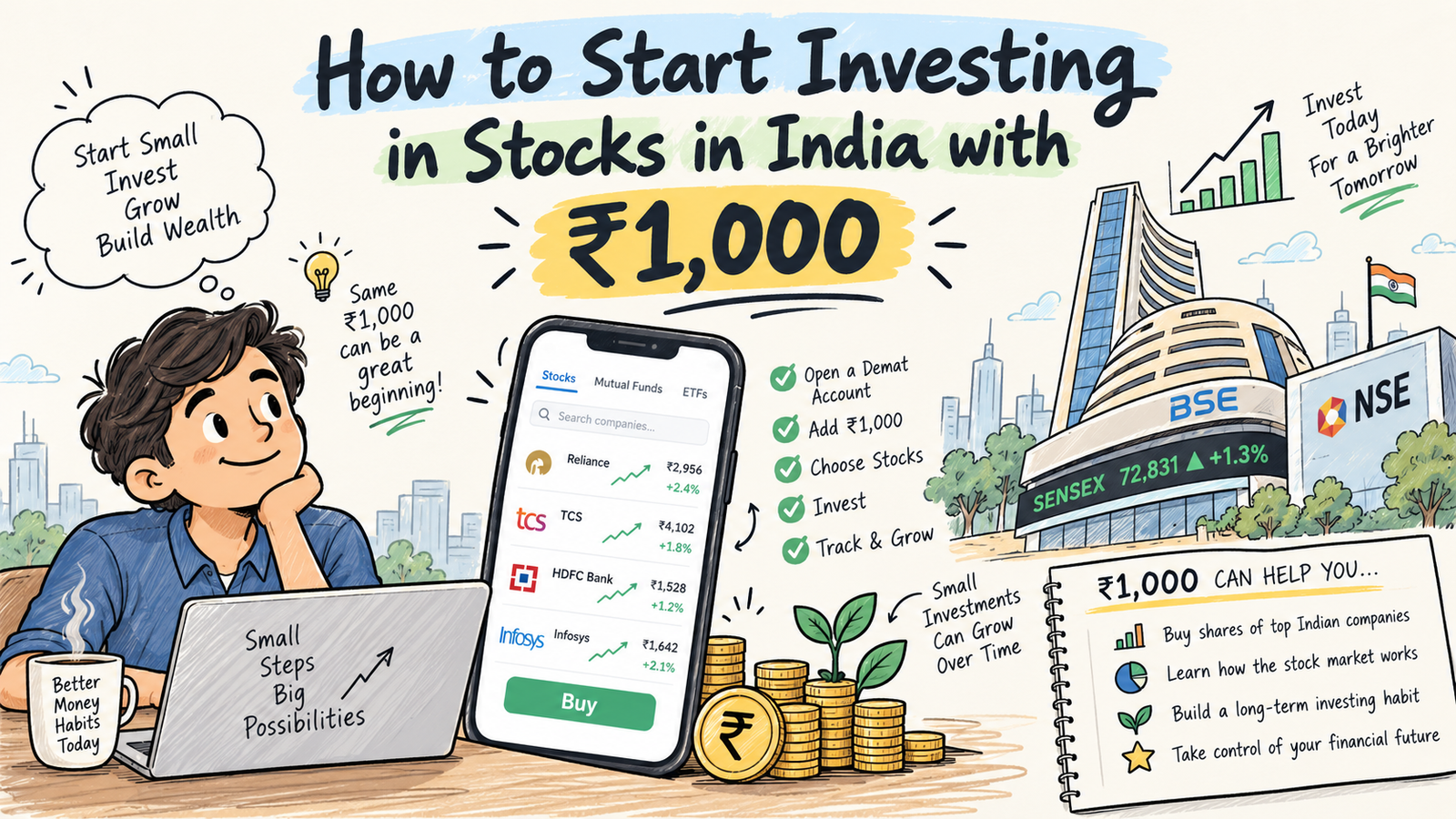
Introduction: Why ₹1,000 Is More Than Enough to Begin
A persistent myth dominates Indian households: you need substantial wealth, five-digit paychecks, or generational capital before touching the stock market. For decades, traditional investing was governed by physical share certificates, minimum parcel sizes, cumbersome courier protocols, and punishing trading commissions that excluded ordinary salaried employees, tier-2 and tier-3 city college students, and homemakers.
That paradigm is completely obsolete. With India’s Unified Payments Interface (UPI), Aadhaar-backed paperless electronic Know Your Customer (e-KYC), and the rise of SEBI-regulated discount brokerages offering zero brokerage on equity delivery, Dalal Street is democratized. Today, exactly ₹1,000 is not merely enough to open an account—it is the ideal proving ground to learn the psychological discipline of asset allocation without threatening your solvency.
Starting with ₹1,000 transforms abstract financial vocabulary into visceral knowledge. You witness firsthand how corporate earnings reports translate into stock price adjustments, how intraday market volatility feels, and how dividend payouts register directly inside your national electronic savings account. You are not placing bets; you are buying productive ownership stakes in profitable Indian enterprises.
The Power of Starting Early: Compound Interest in the Indian Context
Albert Einstein famously described compound interest as the eighth wonder of the world. In the Indian macroeconomic backdrop, where headline inflation typically hovers between 5% and 7%, leaving money parked solely in a savings account delivering 3% or fixed deposits yielding post-tax returns below 6% leads to negative real purchasing power.
Consider the compounding math: If a 21-year-old college graduate commits ₹1,000 every single month into a diversified basket of blue-chip Indian equities yielding a historical conservative compound annual growth rate (CAGR) of 12.5%, the arithmetic of longevity manifests astonishing outcomes:
- In 10 Years: Total deposited ₹1,20,000 grows to approximately ₹2,32,000.
- In 20 Years: Total deposited ₹2,40,000 compounds into roughly ₹9,98,000.
- In 30 Years: Total deposited ₹3,60,000 expands beyond ₹35,30,000.
Notice that during the third decade, the annual returns earned in capital gains outpace the total lifetime physical capital contributed from your salary. The variable that commands maximum influence is not whether your initial note was ₹1,000 or ₹50,000—it is the tenure of uninterrupted compounding.
Prerequisites Before Investing Your First ₹1,000
Before transferring even one rupee into an exchange trading wallet, every prudent Indian retail investor must establish structural hygiene. Rushing into stock trading without addressing foundational prerequisites is the quickest pathway toward emergency liquidation during unexpected life shocks.
1. Permanent Account Number (PAN Card)
Under SEBI guidelines and Income Tax Department statutory regulations, a valid PAN card is mandatory for opening Demat and trading accounts across the National Stock Exchange (NSE) and Bombay Stock Exchange (BSE). Ensure your PAN details perfectly match your banking credentials.
2. Aadhaar Linked to an Active Mobile Number
The contemporary onboarding workflow uses Digilocker and National E-Governance Services Ltd (NeSL) e-Sign. To finalize account opening in ten minutes from your smartphone, your Aadhaar must receive real-time one-time passwords (OTP).
3. Active Indian Bank Account with Net Banking or UPI
Brokers strictly accept deposits from the bank account formally linked to your client ID. Third-party deposits from friends or family bank handles are instantaneously rejected by banking gateways to prevent anti-money laundering violations.
4. A Minimal Emergency Cushion
Never invest money that you will require to pay semester fees, electricity bills, or upcoming rent within 60 days. Your inaugural ₹1,000 must represent surplus discretionary capital whose immediate short-term market valuation will not provoke sleepless nights.
Choosing the Right SEBI-Registered Discount Broker
Historically, full-service brick-and-mortar legacy brokers charged percentage-based brokerages ranging from 0.25% to 0.50% per trade, accompanied by steep annual maintenance charges (AMC) that drained micro-portfolios. In contrast, tech-forward discount brokerages operating under SEBI regulatory oversight offer flat fee models or zero brokerage on delivery orders.
Zerodha (Kite)
India's largest bootstrapped broker. Clean institutional interface, zero brokerage on equity delivery, ₹200 one-time account opening fee.
Groww
Extremely intuitive mobile experience designed for first-time retail investors. Zero account opening fee, simple UPI integration.
Angel One
Combines discount brokerage economics with comprehensive advisory research tools and algorithmic trading APIs for power users.
Regardless of your selected platform, ensure that your broker is directly affiliated with either CDSL (Central Depository Services Limited) or NSDL (National Securities Depository Limited). Your purchased shares reside in your personal Demat depository, not in the broker’s private ledger.
Understanding Brokerage and Account Opening Charges on Small Investments
When operating with a modest capital base of ₹1,000, transaction friction matters significantly. A statutory deduction of ₹30 on a ₹1,000 order equates to a 3% instantaneous drag on your starting principal, demanding a 3% market rally just to break even.
Let us deconstruct the statutory fee anatomy for an Indian Cash Equity Delivery transaction:
Securities Transaction Tax (STT): Levied by the central government at 0.1% on both buy and sell delivery transactions.
Exchange Transaction Charges: NSE charges approximately 0.00297% and BSE charges around 0.00375% of total traded turnover.
SEBI Turnover Turnover Fees: Standardized at ₹10 per crore (negligible on ₹1,000 investments).
Stamp Duty: 0.015% or ₹1,500 per crore on buy orders as mandated by the Indian Stamp Act.
Goods and Services Tax (GST): 18% applied exclusively on brokerage and exchange transaction charges, not on your principal share capital.
Goods and Services Tax (GST): 18% applied exclusively on brokerage and exchange transaction charges, not on your principal share capital.
On a delivery purchase of ₹1,000 worth of shares through a zero-delivery broker, total regulatory friction stays comfortably below ₹3.50. This confirms that small-ticket investing is financially viable without getting cannibalized by hidden fees.
What Can You Actually Buy with ₹1,000?
A frequent source of confusion among new entrants stems from observing premium share prices. Looking at MRF trading above ₹1,30,000 or Page Industries above ₹35,000 leads beginners to assume Indian markets are out of reach. Unlike the United States stock exchanges, Indian markets do not currently facilitate fractional share purchases under the Companies Act, 2013. You must buy at least one full whole unit of an equity share.
Fortunately, hundreds of fundamentally sound blue-chip corporations and institutional instruments trade below ₹1,000 per share:
Accessible Large-Cap Companies (Indicative Trading Ranges)
- State Bank of India (SBIN): India’s largest public lender, trading frequently between ₹750 – ₹850 per share.
- Tata Steel (TATASTEEL): A core infrastructure titan, currently trading around ₹140 – ₹170 per share.
- ITC Limited (ITC): Premier FMCG and paper conglomerate, trading between ₹430 – ₹480 per share.
- Wipro Limited (WIPRO): Global IT services enterprise, trading around ₹480 – ₹560 per share.
- Bharat Electronics (BEL): Premier defense public sector undertaking, trading around ₹280 – ₹320 per share.
With ₹1,000, you can readily procure 1 share of SBI, or 2 shares of ITC, or 6 shares of Tata Steel, instantly becoming a fractional equity co-owner of blue-chip national infrastructure.
Why Nifty 50 ETFs (NIFTYBEES) Are the Best Starting Vehicle for Small Capital
While purchasing individual corporate shares is satisfying, it concentrates 100% of your ₹1,000 capital into a single business entity. If that specific firm encounters a quarterly earnings deficit or management transition, your micro-portfolio suffers immediate concentration volatility.
The single most intelligent starting vehicle for small capital is an Exchange Traded Fund (ETF), specifically Nippon India ETF Nifty BeES (ticker: NIFTYBEES) or SBI Nifty 50 ETF.
Unmatched Structural Advantages of NIFTYBEES:
1. Instant 50-Company Diversification: One single unit of NIFTYBEES trades around ₹250 to ₹270. By purchasing three units for ~₹800, you obtain proportional equity ownership in Reliance Industries, TCS, HDFC Bank, Infosys, Larsen & Toubro, ICICI Bank, and 44 other corporate stalwarts simultaneously.
2. Microscopic Expense Ratio: ETFs feature annual expense ratios as low as 0.04% to 0.08%, compared to 1.5% to 2.2% in actively managed retail mutual fund regular plans.
3. Zero Minimum Lock-in: You hold full liquid flexibility to accumulate, hold, or sell at prevailing real-time exchange quotes during market hours (9:15 AM to 3:30 PM IST).
4. Automated Self-Cleansing: The Nifty 50 index operates on a semi-annual rebalancing schedule. Struggling companies that lose market cap are automatically removed and replaced by emerging industry leaders without any action required from you.
For retail investors beginning with ₹1,000, deploying capital into 3 to 4 units of NIFTYBEES eliminates company-specific bankruptcy risk entirely.
Step-by-Step Execution: Placing Your Very First Market or Limit Order
Once your Demat account is approved by your chosen broker, executing your inaugural order requires less than two minutes. Follow this systematic playbook:
Add Funds via UPI
Navigate to the 'Funds' or 'Wallet' segment of your trading mobile application. Click 'Add Funds', input ₹1,000, and approve the immediate zero-charge UPI mandate using Google Pay, PhonePe, or BHIM.
Search the Script Symbol
Type "NIFTYBEES" or your desired stock ticker (e.g., "ITC") into the market watchlist search bar. Add the NSE cash equity segment listing to your active watchlist.
Select Order Type: Delivery (CNC)
Crucial step: Always select Delivery / CNC (Cash 'N Carry). Never select 'Intraday (MIS)', which will forcefully liquidate your shares at 3:15 PM the same afternoon.
Choose Market vs Limit Order
A Market Order executes immediately at the lowest available prevailing ask price on the exchange. A Limit Order allows you to define the exact maximum price you are willing to pay. For small-ticket liquid ETFs, a Limit Order placed at or slightly below the last traded price prevents unfavorable slippage.
Swipe to Submit & Verify Settlement (T+1)
Review order details, swipe to confirm, and receive an instant order execution SMS. Under India's modern T+1 settlement cycle, your shares settle cleanly into your CDSL/NSDL Demat repository by the subsequent working business day.
The Golden Rules of Risk Management for Small Portfolios
Managing risk when starting with ₹1,000 is not about hedging with exotic derivatives—it is about cultivating psychological immunity to market fluctuations and safeguarding your investment temperament.
Rule 1: Accept the Cost of Learning
Treat your inaugural ₹1,000 as tuition fees paid to the financial markets. The primary objective is learning the mechanics of market depth, settlements, corporate actions, and emotional discipline.
Rule 2: Delete Intraday Tickers from Your Screen
Checking stock price quotes twenty times a day creates anxiety and provokes emotional, unnecessary trading. Wealth creation in equities is a slow, multi-year process.
Rule 3: Ignore Social Media "Tips" and Telegram Groups
Unregistered operators frequently run pump-and-dump schemes on illiquid micro-cap stocks targeting naive retail investors on messaging platforms. Never purchase an asset you cannot independently explain to a peer.
Systematic Investment Plans (SIPs) in Direct Stocks vs Mutual Funds
Once you have executed your first manual trade of ₹1,000, you face a strategic choice: continue investing manually every month, establish a Stock SIP via your broker, or set up an automated Mutual Fund SIP. Both paths offer distinct merits:
trending_up Direct Equity / ETF SIP
- • Instant liquidity at live exchange pricing.
- • No fund management expense ratio drag.
- • Full control over company selection and allocation.
- • Demands personal discipline to maintain orders during market pullbacks.
pie_chart Mutual Fund SIP
- • Automated bank auto-debit (NACH mandate) eliminating friction.
- • Fractional NAV allocation (exact ₹1,000 invested down to decimal units).
- • Professional fund manager oversight and active reallocation.
- • Slight expense ratio fee (0.3% – 0.8% for direct index plans).
The Recommended Hybrid Path: Set up a core automated ₹500 monthly SIP into a low-cost Nifty 50 Direct Index Mutual Fund for consistent compounding, while using an additional ₹500 monthly tranche to manually accumulate shares of blue-chip companies or NIFTYBEES on your discount brokerage app.
Common Mistakes Beginners Make with ₹1,000
Small initial capital can foster a harmful psychological bias: because the nominal sum is modest, novice investors treat it like lottery money rather than investment capital. Avoid these classic beginner traps:
Mistake 1: Chasing Penny Stocks ("Quantity Over Quality" Fallacy)
Beginners often believe owning 500 shares of a ₹2 dying penny stock is superior to owning 2 shares of a ₹500 blue-chip leader. In reality, a company with declining revenues, heavy debt, and poor governance will erode capital regardless of how many units you hold.
Mistake 2: Intraday Trading and Margin Leverage
Broker apps offer 5x leverage on intraday positions, allowing ₹1,000 to trade ₹5,000 worth of shares. A tiny 2% adverse market move wipes out 10% of your capital within minutes. SEBI data consistently reveals that over 90% of active retail intraday traders incur net financial losses.
Mistake 3: Venturing into Futures & Options (F&O)
Lured by social media screenshots showcasing exponential option-buying gains, beginners attempt to trade out-of-the-money weekly call/put options. In derivatives, time decay (Theta) steadily erodes value, resulting in total capital loss for inexperienced retail participants.
Frequently Asked Questions
Can I really buy shares with just ₹1,000 in India?
Yes. Under SEBI regulations, there is no minimum capital barrier to invest in the Indian stock market. You can purchase a single share of any publicly listed company whose price is below ₹1,000, or invest in Exchange Traded Funds like NIFTYBEES starting from around ₹250.
Is a Demat account mandatory to invest in stocks?
Yes, a Demat account is legally required to hold direct equities and ETFs in electronic format with depositories (CDSL/NSDL). However, if you invest in Mutual Funds through direct asset management company (AMC) portals or mutual fund platforms, shares can be held in Statement of Account (SOA) format without a standalone Demat.
Do I have to pay tax on ₹1,000 invested in equities?
You only pay tax when you sell your holdings at a profit (capital gains) or receive dividends. Under the updated FY 2024-25 Union Budget tax guidelines, Long-Term Capital Gains (held over 1 year) are taxed at 12.5% on gains exceeding ₹1.25 Lakh per financial year. Short-Term Capital Gains (held under 1 year) are taxed at 20%. Simply holding stocks incurs zero tax liability.
What happens if the stock price drops after I invest my ₹1,000?
Any downward movement reflects an "unrealized loss" (paper loss). As long as you purchased via Delivery (CNC) and do not click sell, you continue to own your units. High-quality Indian enterprises routinely experience temporary market corrections before resuming long-term compounding.
Can college students without a salary slip open a Demat account?
Yes. Any Indian citizen aged 18 or above with a PAN card, Aadhaar, and a standard savings bank account can open a trading and Demat account. Income proof (such as salary slips or ITR acknowledgments) is only mandatory if you activate derivative trading segments (F&O), which beginners should avoid.
How do I receive dividends on my ₹1,000 investment?
When a company you own declares a dividend, the money does not go to your broker wallet; it is directly credited to your linked primary bank account via National Electronic Funds Transfer (NEFT) or ECS on the statutory dividend payout date.
Is my ₹1,000 safe if my discount broker goes bankrupt?
Yes. Brokers in India act solely as execution intermediaries. Your delivery shares are held securely in your name within quasi-governmental depositories (CDSL or NSDL). Even if a brokerage shuts down operations, your equity holdings remain safe and can be accessed or transferred to any other SEBI-registered broker.
How frequently should I add more capital after my first ₹1,000?
Consistency trumps timing. Establishing a regular schedule—such as deploying ₹1,000 on the 1st or 5th of every month right after receiving your paycheck or stipend—harnesses Rupee Cost Averaging, smoothing out market highs and lows over the long run.
Key Takeaways: Foundational Rules for ₹1,000 Investing
check_circle
Capital Barrier is Gone: ₹1,000 gives you authentic equity co-ownership in established Indian blue-chip corporations.
check_circle
Start with NIFTYBEES: Buying index ETFs provides instant 50-stock diversification, protecting you from single-company shocks.
check_circle
Always Select Delivery (CNC): Never risk your initial capital in Intraday (MIS) leverage or speculative F&O bets.
check_circle
Compounding is Time-Bound: Developing a disciplined monthly cadence of ₹1,000 creates multi-lakh wealth over a 15-year horizon.