
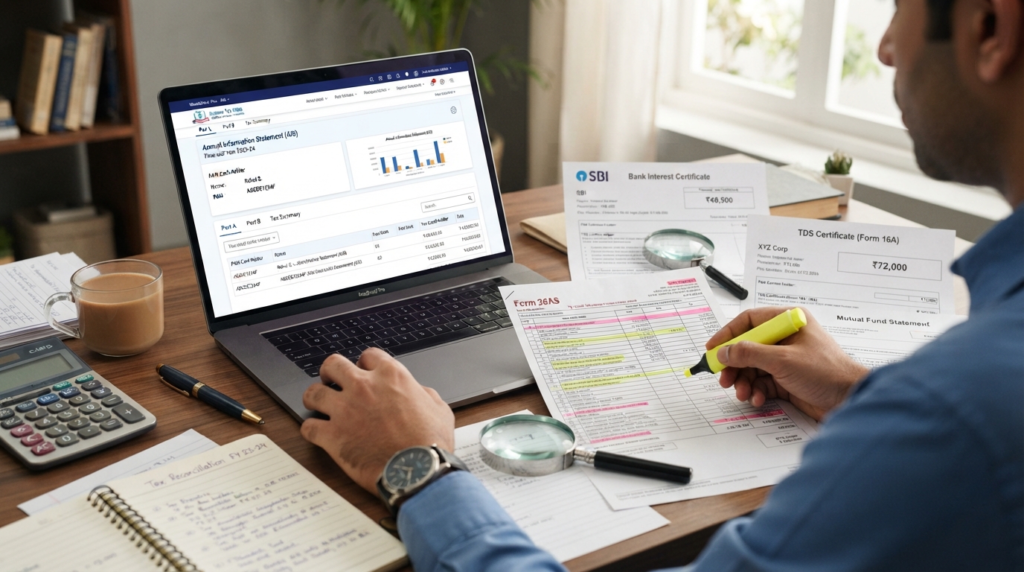
Introduction: The Age of Automated Tax Surveillance in India
Gone are the days when filing an Income Tax Return (ITR) in India was merely a self-declaratory exercise based on whatever salary slips or investment receipts were handed over to an accountant at the end of July. Over the last five financial years, the Income Tax Department of India has undergone a historic technological overhaul driven by Project Insight, massive cross-entity data warehousing, and the autonomous algorithms of the Centralized Processing Center (CPC 3.0) located in Bengaluru.
Today, before an individual even logs into the e-filing portal to prepare their return, the tax department already maintains a comprehensive real-time balance sheet of their economic existence. Every trade executed on the National Stock Exchange (NSE) or Bombay Stock Exchange (BSE), every domestic or international credit card transaction exceeding thresholds, real estate registrations, mutual fund systematically routed systematic investment plans (SIPs), and even savings account interest accrued overnight are transmitted via mandatory Statement of Financial Transactions (SFT) reporting directly to your Permanent Account Number (PAN).
Under CPC 3.0 rules, your uploaded ITR is machine-compared in seconds against your three official statutory registries: Form 26AS, the Annual Information Statement (AIS), and the Taxpayer Information Summary (TIS). Any unaddressed numeric variation no longer waits three years for an audit notice—it triggers automated computational intimations under Section 143(1)(a) within 72 hours of filing.
Understanding Form 26AS (The Annual Tax Statement)
Form 26AS is your official, legally binding consolidated tax credit statement issued under Rule 31AB of the Income Tax Rules, 1962. It functions essentially as a passbook of all taxes deposited against your PAN with the Union Government of India during a financial year.
While Form 26AS was historically the sole source of verification, it is now strictly dedicated to showing realized tax collections, withholding credits, advance deposits, and statutory refund receipts. It is structured into clearly partitioned schedules:
Part A: Details of Tax Deducted at Source (TDS)
Records all tax deducted on your behalf by employers under Section 192 (Salary), by Scheduled Commercial and Cooperative Banks under Section 194A (Fixed & Recurring Deposit interest), by corporations distributing equity dividends under Section 194, and by businesses paying professional contracts under Section 194J or Section 194C. Crucially, each entry indicates the Tax Deduction and Collection Account Number (TAN) of the deductor, total sum paid, and corresponding tax credited to the exchequer.
Part B: Details of Tax Collected at Source (TCS)
Mandatorily captures levies gathered from you by sellers or intermediaries under Section 206C. Notable examples include TCS deducted by authorized dealer banks on outward foreign remittances under the Liberalised Remittance Scheme (LRS), overseas tour packages, purchase of motor vehicles exceeding ₹10 Lakhs, and scrap sales. This TCS directly cushions your total tax liability during computation.
Part C: Details of Tax Paid Other than TDS or TCS (Challan 280)
Details all payments made directly by you through authorized bank branches or online TIN-protean / e-filing channels using Challan 280. This records your Advance Tax installments (due June 15, Sept 15, Dec 15, and March 15) and any Self-Assessment Tax paid prior to return dispatch, verifying the BSR Code, Challan Date, and Challan Serial Number.
Part D: Details of Paid Income Tax Refunds
Shows all historical refunds issued to your pre-validated bank account by CPC during the assessment year, alongside statutory interest paid by the Central Government under Section 244A. Crucial tax note: While the principal refund is non-taxable capital, the Section 244A interest component is fully taxable under 'Income from Other Sources' and must be accounted for in your filing.
Part E & Part F: SFT High-Value Items & Real Estate TDS (Section 194-IA / 194-IB)
Covers specialized property transactions. Part F details TDS withheld when purchasing immovable land or buildings exceeding ₹50 Lakhs under Section 194-IA (via Form 26QB), or residential rent paid by individuals exceeding ₹50,000 per month under Section 194-IB (via Form 26QC).
Understanding AIS (Annual Information Statement)
If Form 26AS is your tax withholding passbook, the Annual Information Statement (AIS) is the comprehensive financial diary of your life. Introduced to promote voluntary compliance and prevent under-reporting of capital income, AIS tracks economic transactions irrespective of whether tax was deducted at source.
The Multi-Institutional Pipeline Feeding Your AIS
- Stock Exchanges (NSE, BSE, MCX): Transmits turnover, contract notes, equity swing trades, futures and options turnover metrics.
- Depositories (NSDL & CDSL): Reports off-market share transfers, gift of equity units, and demat holding shifts.
- Mutual Fund RTAs (CAMS & KFintech): Dispatches redemptions, switches between regular and direct plans, and dividend payouts.
- Scheduled Banks & NBFCs: Reports savings interest, term deposit receipts, credit card bills settled over ₹1 Lakh in cash or ₹10 Lakhs in digital transfers, and cash deposits over ₹10 Lakhs.
- State Sub-Registrars (Inspector General of Registration): Transmits registered purchase or sale deed valuations of land, apartments, and commercial units.
Key High-Frequency Information Buckets in AIS
AIS categorizes your data into clear financial sectors. The most critical include:
- Gross Stock and Mutual Fund Sale Consideration: Captures the aggregate value of all equities and units liquidated during the fiscal year. Warning: AIS lists the gross turnover, not your net capital gain or indexed cost of acquisition.
- Dividend Payouts: Every single Rupee of equity or mutual fund dividend credited directly to your bank mandate without TDS threshold caps.
- Savings Bank Interest Accruals: Aggregated reporting from every operational savings account linked to your PAN, including forgotten salary accounts or zero-balance accounts.
- Foreign Exchange Purchases & Inward Remittances: Details currencies bought for overseas education, tourism, or wire transfers received from foreign employers or software client billings.
- Rent Received & High-Value Goods Purchase: Discloses landlord PAN quotes used by tenants for HRA claims, as well as luxury watch, jewelry, or art acquisitions exceeding statutory limits.
Understanding TIS (Taxpayer Information Summary)
While AIS offers granular, item-by-item operational details (which can span dozens of pages for active traders), the Taxpayer Information Summary (TIS) is an executive synthesis generated algorithmically from AIS.
TIS groups thousands of disparate micro-transactions under standardized tax heads:
Reported AIS Value
The literal, raw sum collected from external reporting agencies (such as broker turnover or bank interest files). It may contain joint account duplications, erroneous trades, or canceled transactions.
Processed TIS Value
The adjusted figure computed after processing taxpayer feedback, deduplication rules, and institutional updates. This precise processed sum automatically auto-populates your ITR-1, ITR-2, or ITR-3 schedules.
The Three-Way Reconciliation Protocol (Step-by-Step)
To achieve a zero-defect ITR submission and eliminate notice risks, every Indian taxpayer must implement the Three-Way Reconciliation Protocol prior to verifying their return.
Step 1: Reconcile Form 16 / 16A TDS Credits Against Form 26AS
Cross-verify every rupee of TDS shown on your employer's Form 16 (Part A) and your bank's Form 16A against the credits reflected in Form 26AS. Ensure that the deductor's TAN, the quarterly period, and the credited deposit amounts match down to the exact decimal. If your employer deducted ₹1,80,000 as TDS but Form 26AS reflects only ₹1,35,000, do not assume it will resolve itself. The CPC portal will reject the ₹45,000 difference during automatic processing, issuing a demand notice with interest.
Step 2: Compare AIS Stock & Mutual Fund Transactions with Broker Realized Statements
Download the Tax P&L Statement directly from your stockbroker (Zerodha, Groww, ICICI Direct, Upstox, etc.) and your mutual fund consolidated capital gains statement from CAMS/KFintech. Compare the total gross sale consideration in your statements with the corresponding line items in AIS under category 'Sale of Securities & Units of Mutual Funds'.
Note: Stockbrokers report trade value on a gross settlement basis, while corporate actions (like bonus shares, splits, or buybacks) might appear as unpriced acquisitions. Verify that off-market transfers or intra-demat reorganizations are not erroneously categorized as taxable open-market sales.
Step 3: Match Bank Savings and Term Deposit Interest Across Passbooks, AIS, and Form 26AS
Obtain annual Interest Certificates from every commercial, regional rural, and cooperative bank where you hold an active account. Remember that banks only deduct Section 194A TDS if total annual interest across branches exceeds ₹40,000 (₹50,000 for senior citizens). However, all savings bank interest is taxable under the head 'Income from Other Sources' (subject to Section 80TTA deduction of up to ₹10,000 under the Old Regime). Ensure the aggregate of passbook credit entries tallies with the AIS savings interest lines.
How to Submit Online Feedback in AIS for Incorrect Information
If you discover erroneous entries, phantom transactions, or duplicate records in your AIS, the Income Tax Department allows you to challenge the data directly within the e-filing portal before filing your ITR.
When you expand any individual transaction record within AIS, you are presented with five formal statutory feedback options:
Real-Time Impact on TIS Processed Value
Once you submit your feedback, the system recalculates the TIS Processed Value immediately. For instance, if you mark a duplicate ₹50,000 dividend entry as 'Duplicate', the TIS reduces the taxable dividend baseline by ₹50,000. While the reporting source is given time to accept or contest your feedback, your return can proceed based on your justified submission.
Red Flags That Trigger CPC Automated Mismatch Notices under Section 143(1)(a) and Section 133(6)
The Centralized Processing Center algorithms are pre-programmed with risk matrices. The following deviations routinely trigger automated discrepancy communications:
warning Red Flag 1: Claiming Higher TDS Credit Than Present in Form 26AS
If an employer or client furnished a physical TDS certificate or salary pay-slip showing ₹75,000 deduction, but your Form 26AS shows only ₹50,000 (because the employer missed quarterly TDS filing deadlines), claiming the full ₹75,000 will cause CPC to reject the ₹25,000 excess and disallow your claim under Section 143(1)(a).
warning Red Flag 2: Omitting Minor Savings Interest or Equity Dividends Displayed in AIS
Many filers assume small dividend payments (e.g., ₹250 from 10 different stocks) or minor savings bank interest (e.g., ₹4,300) are exempt or trivial. Because every one of these entries exists in AIS, CPC routines flag non-disclosure as an apparent error of under-reporting, adding the omissions to your total income at your maximum marginal slab rate.
warning Red Flag 3: Turnover Variance Between ITR and GST Returns (GSTR-1 / GSTR-3B)
For professionals, consultants, and sole proprietors filing under ITR-3 or ITR-4 (Presumptive Taxation Section 44ADA/44AD), the CPC system links directly with the Goods and Services Tax Network (GSTN). If your aggregate gross receipts declared in ITR do not harmonize with your GSTR-1 turnover, a notice under Section 133(6) seeking documentary reconciliation is dispatched automatically.
Step-by-Step Practical Troubleshooting Guide for Taxpayers
When standard numbers fail to align, follow these actionable remedies:
Scenario A: Your Employer or Bank Deducted TDS But It Does Not Appear in Form 26AS
- Verify your PAN spelling on the physical salary slip or interest certificate.
- Demand the Quarterly Filing Acknowledgement (Form 24Q for employers or Form 26Q for banks) to check if your row was omitted or flagged with a PAN error.
- Request that the deductor file a Revised TDS Return using TIN-protean. Once updated, your Form 26AS will reflect the credit within 7 to 10 working days.
Scenario B: Joint Bank Accounts Where 100% of the Interest is Allocated to the Primary Account Holder
Indian commercial banks routinely assign 100% of recurring/fixed deposit interest to the primary account holder's PAN in their SFT reporting, even when the funds were contributed by the secondary holder.
Frequently Asked Questions (FAQ)
When is the final cutoff for AIS updates for Quarter 4 transactions?
Institutional reporting entities (banks, mutual fund RTAs, and stockbrokers) have until May 31st following the end of the financial year to upload their Q4 SFT declarations. Consequently, filers should wait until at least June 10th to 15th before initiating their reconciliation, ensuring all fourth-quarter corporate dividend distributions and capital transactions are reflected.
What is the distinction between 'Active Value' and 'Processed Value' in TIS?
The Active Value represents the initial unedited metric supplied directly by third-party data providers. The Processed Value is the operational outcome derived after applying the taxpayer's feedback, removing verified duplicates, and correcting mistaken identity credits. The pre-fill logic in ITR forms pulls strictly from the Processed Value.
Does Form 26AS report foreign outward remittances sent for overseas education?
Yes. Under Section 206C(1G), authorized dealer banks collect TCS on foreign remittances exceeding ₹7 Lakhs under LRS. This TCS is captured in Part B of Form 26AS. You can claim full credit for this TCS against your overall tax liability or obtain it as a refund if your computed tax liability is lower.
Key Takeaways: The 5 Golden Rules of Tax Reconciliation
Before hitting 'Submit' on your Income Tax Return for FY 2026–27, commit these mandatory fundamentals to memory:
check_circle
Rule 1: Never file before mid-June
Allow banks, depository participants, and employers sufficient runway to complete their mandatory statutory Q4 SFT filings by May 31st.
check_circle
Rule 2: Form 26AS is the baseline for tax withholding credit
If a TDS amount appears in your salary certificate but does not appear in Form 26AS, resolve it with your deductor first before claiming the credit.
check_circle
Rule 3: AIS reports gross turnover, not net capital gain
Never copy raw AIS equity or mutual fund sale figures directly into your ITR capital gains schedules without factoring in indexed acquisition costs and brokerage fees.
check_circle
Every interest credit is reported by banks under SFT codes; omitting even small balances invites automated Section 143(1)(a) discrepancy intimations.
check_circle
Never leave unverified records unanswered in your AIS; submitting structured online feedback aligns the TIS Processed Value to your real financial position.