
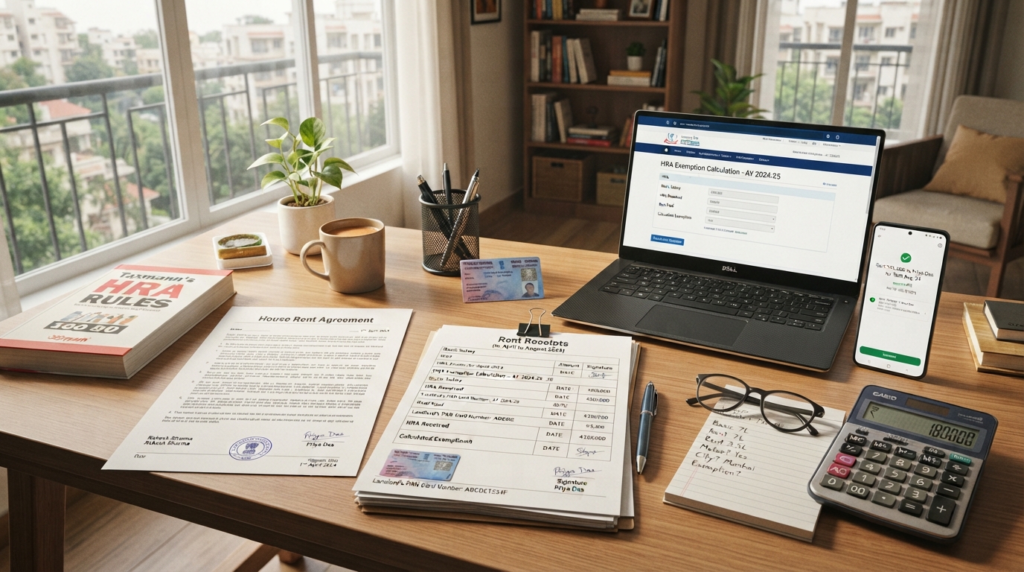
Understanding HRA as a Salary Component under Section 10(13A) and Rule 2A
House Rent Allowance (HRA) is one of the most substantial and frequently claimed salary components for Indian tenants working across metropolitan hubs and tier-two industrial centers. Established under Section 10(13A) of the Income Tax Act, 1961, read in conjunction with Rule 2A of the Income Tax Rules, 1962, the primary legislative intent behind this allowance is to mitigate the financial friction of residential accommodation costs incurred by an employee in connection with their employment.
However, an imperative statutory distinction must be understood from day one: HRA is not an automatic tax exemption. When an employer allocates an allowance labelled "HRA" inside your monthly compensation breakdown (Cost to Company or CTC), the allowance itself enters the tax calculation as fully taxable income by default. It transforms into an exempt, non-taxable entity only to the extent that you satisfy statutory criteria and incur actual financial outgo toward residential rent.
If you reside in a self-owned residential property, live rent-free with family members without executing legally verifiable lease terms, or fail to produce statutory documentation, the entire quantum of HRA distributed by your payroll department remains taxable at your marginal slab rate.
Crucial FY 2026–27 Regime Restriction: Old vs. New Tax Regime
Under Section 115BAC of the Income Tax Act, the New Tax Regime serves as the default tax framework for all individual taxpayers. House Rent Allowance (HRA) under Section 10(13A) is strictly disallowed under the New Tax Regime.
For the financial year 2026–2027 (Assessment Year 2027–2028), salaried employees face an absolute zero-exemption policy for HRA under the revised default regime. If you choose or remain opted into the New Tax Regime:
- Your entire House Rent Allowance is combined directly with your gross taxable salary without any deduction.
- No rent agreements, landlord PAN declarations, or monthly rent receipts can be submitted to your employer or adjusted in your final Income Tax Return.
- The concession given under the New Regime is limited strictly to revised progressive slab percentages and standard deductions.
Conversely, if you opt to file under the Old Tax Regime, you retain complete statutory eligibility to compute and claim HRA exemptions under Rule 2A, along with Chapter VI-A deductions (such as Section 80C, 80D) and Section 24(b) home loan interest. Consequently, salaried professionals paying steep monthly rents in cities like Mumbai, Bengaluru, or Delhi NCR must calculate both frameworks meticulously before declaring their preferred regime to corporate payroll portals at the beginning of the financial year.
The Statutory HRA Exemption Formula: The "Least of the Three" Rule
The quantum of HRA immune from income tax is determined strictly through an arithmetic comparison mandated by Rule 2A. The exempt amount is prescribed as the lowest (least) among the following three distinct calculations:
Condition A: Actual HRA Received
The total gross House Rent Allowance paid directly to you by your employer during the relevant financial assessment period.
Condition B: Rent Paid in Excess of 10% of Salary
Actual total residential rent paid during the year minus 10% of the defined "Salary" for the exact corresponding duration.
Condition C: Statutory Percentage Cap (50% or 40%)
50% of defined "Salary" if the residential accommodation is located within the 4 constitutional Metros (Delhi, Mumbai, Kolkata, Chennai), OR 40% of "Salary" for all other locations across the territory of India.
Many salaried professionals make the costly error of utilizing their total gross compensation or "Cost to Company" (CTC) when calculating the 10%, 40%, or 50% thresholds. Under Income Tax Rule 2A, "Salary" is strictly limited to:
Special allowances, conveyance allowances, medical reimbursements, annual performance incentives, and non-turnover discretionary bonuses are statutorily excluded from the definition of "Salary" for HRA calculations.
Metro vs. Non-Metro Classification Nuance: The Archaic Four-City Trap
A persistent point of confusion among modern software engineers and corporate employees relates to the designation of "Metropolitan" areas for HRA exemptions. While common commercial understanding considers cities such as Bengaluru, Hyderabad, Pune, Gurugram, and Noida as primary metropolises, the Income Tax Act maintains an archaic four-city definition drafted in the mid-twentieth century.
Under statutory Rule 2A, the elevated 50% cap is exclusively restricted to properties situated within the municipal limits of:
- Delhi (National Capital Territory)
- Mumbai (including Mumbai Suburban)
- Kolkata
- Chennai
All other urban conglomerates including the primary technological hubs of Bengaluru, Hyderabad, Ahmedabad, Pune, Gurugram, and Navi Mumbai are categorized under the 40% non-metro rate. Despite multiple recommendations made before the Parliamentary Standing Committee on Finance and representations from premier industrial bodies like NASSCOM, this legislative classification remains unamended for FY 2026–2027.
Mandatory Documentation & Statutory Compliance Framework
Claiming HRA requires adherence to documented evidentiary trails. Employers and the Income Tax Department operate under strict verification protocols to combat fraudulent rent entries.
A valid tenancy agreement executed on appropriate stamp paper (physical non-judicial stamp or state e-stamping) containing explicit lease tenure, tenancy start date, monthly rental amount, utility distribution clauses, and physical address details matching the employee's claimed residence.
Rent receipts containing landlord signature, rent period, payment date, and method of dispatch. If cash payments exceed ₹5,000 per receipt, affixing an Indian ₹1 revenue stamp across the landlord signature is a mandatory legal requirement under the Indian Stamp Act.
As per CBDT Circular No. 08/2013, if annual aggregate rent paid exceeds ₹1,00,000 (approx. ₹8,333 per month), quoting the Permanent Account Number (PAN) of the landlord to your employer is mandatory. In the absence of a PAN, an official declaration (Form 60) along with landlord contact details must be produced.
If your monthly rent exceeds ₹50,000 (or part of a month), individual tenants are legally mandated to deduct Tax Deducted at Source (TDS) under Section 194-IB. The prevailing rate stands at 2% (reduced from the earlier 5% rate by recent Finance Acts). The tenant must deduct this TDS during the last month of the tenancy year or upon vacation, deposit it using Challan-cum-statement Form 26QC within 30 days, and issue Form 16C to the landlord. Failure to deduct TDS attracts interest and penal liabilities under Sections 201 and 271C.
Practical Case Studies & Numerical Simulations
To understand the mechanics of the "Least of Three" rule in real-world scenarios, review these two comprehensive situations for FY 2026–2027:
- Annual Basic Salary: ₹6,00,000 (₹50,000/month, No DA)
- HRA Received from Company: ₹2,40,000 per annum
- Actual Rent Paid in Mumbai: ₹3,60,000 per annum (₹30,000/month)
1. Actual HRA Received = ₹2,40,000
2. Rent Paid minus 10% of Salary: ₹3,60,000 - ₹60,000 (10% of ₹6L) = ₹3,00,000
3. 50% of Basic Salary (Mumbai Metro): 50% of ₹6,00,000 = ₹3,00,000
Exempt HRA = Least of (₹2,40,000; ₹3,00,000; ₹3,00,000) = ₹2,40,000.
Taxable HRA = ₹2,40,000 - ₹2,40,000 = ₹0 (100% Tax Free).
- Annual Basic Salary: ₹12,00,000 (₹1,00,000/month, No DA)
- HRA Received from Company: ₹5,00,000 per annum
- Actual Rent Paid in Indiranagar, Bengaluru: ₹5,40,000 per annum (₹45,000/month)
1. Actual HRA Received = ₹5,00,000
2. Rent Paid minus 10% of Salary: ₹5,40,000 - ₹1,20,000 (10% of ₹12L) = ₹4,20,000
3. 40% of Basic Salary (Bengaluru Non-Metro): 40% of ₹12,00,000 = ₹4,80,000
Exempt HRA = Least of (₹5,00,000; ₹4,20,000; ₹4,80,000) = ₹4,20,000.
Taxable HRA = ₹5,00,000 - ₹4,20,000 = ₹80,000 (Added to Gross Taxable Income).
Legitimate Tax Planning: Paying Rent to Parents vs. Spouses
Indian salaried taxpayers frequently consider paying rent to family members to optimize household tax liability. While legally permissible under specific frameworks, strict adherence to substance-over-form jurisprudence is mandatory.
Paying Rent to Parents: Valid Legal Criteria
You can legitimately claim an HRA exemption by paying rent to your parents, provided the following factual and procedural conditions are completely met:
- Legal Ownership: The residential premises must be owned exclusively or jointly by your parents. You cannot be a co-owner of the property in the municipal records or sale deed.
- Banking Channels: Rent payments must be conducted through traceable electronic transfers (NEFT, RTGS, UPI, or Account Payee Cheques). Cash transactions are easily questioned during income tax scrutiny.
- Tax Declaration by Parents: The receiving parents must declare this rental revenue under “Income from House Property” in their own respective Income Tax Returns. They are entitled to claim the statutory 30% standard deduction under Section 24(a) on the gross rent received, as well as deduct municipal property taxes paid.
Paying Rent to Spouse: Why It Fails Judicial Scrutiny
Attempting to claim HRA by paying rent to your husband or wife is consistently disallowed by Income Tax Assessing Officers and Appellate Tribunals (including landmark ITAT rulings). The marital relationship implies a legal and moral obligation to cohabit together.
Furthermore, under Section 64(1)(iv) of the Income Tax Act, the clubbing of income provisions applies: income arising directly or indirectly to a spouse from assets transferred without adequate consideration is clubbed back into the hands of the transferring spouse. Paying rent to your spouse for a home you jointly share is deemed a sham arrangement to evade taxation.
Can You Claim Both HRA and Home Loan Deductions Simultaneously?
Yes. A widespread misconception among salaried borrowers is that holding an active home loan automatically invalidates HRA eligibility. The Income Tax Act allows you to claim both HRA under Section 10(13A) AND home loan deductions (Section 24(b) interest up to ₹2,00,000 and Section 80C principal repayment up to ₹1,50,000), provided your living arrangements satisfy clear real-world criteria:
Scenario 1: Property in a Different City
You own a self-occupied residential unit in your home city (e.g., Jaipur or Lucknow) where your family resides or which is kept for personal visits, but you reside in a rented apartment in Gurugram or Bengaluru due to corporate employment commitments. You can claim full HRA for the rented apartment while simultaneously claiming home loan tax benefits on the outstation property.
Scenario 2: Property in the Same City but Uninhabitable or Distant
If your owned property is situated in the same metropolitan area but you are forced to rent closer to your work premises due to severe commute distances, or because your owned unit is currently under construction, you may claim both. However, if the owned property is completed and rented out to another third party, you must declare that rental income under "Income from House Property" while claiming HRA for your rented home.
What if Your Employer Doesn't Provide HRA? Section 80GG Relief
Not all working professionals receive an explicit HRA component in their salary. Self-employed freelancers, consultants, professionals, and employees working for smaller businesses often receive a consolidated salary or professional fees without HRA categorization.
In such circumstances, relief is provided under Section 80GG of Chapter VI-A. To claim Section 80GG:
- You must file Form 10BA verifying that you do not own residential property in the city where you reside or perform work duties.
- Neither you, your spouse, nor your minor child should own residential accommodation at your work location.
The deduction under Section 80GG is restricted to the lowest of:
Note: While helpful for entry-level professionals, the ₹5,000 monthly statutory cap under Section 80GG has not been indexed to real-estate inflation since 1998, making it far less beneficial than the uncapped Section 10(13A) HRA exemption.
Frequently Asked Questions (FAQ)
Can I claim HRA if I share a rented flat with colleagues or roommates?
Yes. If you share a tenancy, ensure that your name is explicitly drafted as a co-tenant in the registered rental agreement. The agreement or an accompanying addendum should stipulate your specific percentage share of the monthly rent. You can only claim HRA on the exact portion of rent paid directly through your bank account to the landlord.
Can I claim HRA directly in my ITR if I missed the employer Form 16 deadline?
Yes. If you missed submitting rent receipts to your employer's HR portal before annual payroll cutoffs, your employer will deduct higher TDS without factoring in HRA. You are entitled to calculate your HRA exemption independently and enter the revised taxable salary when filing your Income Tax Return (ITR-1 or ITR-2), claiming a refund for the excess TDS deducted. Ensure you preserve all rental receipts, lease deeds, and bank transaction statements to substantiate your claim in case of departmental inquiries.
What should I do if my landlord does not possess or refuses to provide a PAN?
If annual rent exceeds ₹1,00,000 and the landlord does not hold a PAN, you must obtain a signed declaration under Form 60 from the landlord confirming they have not been allotted a PAN, along with their permanent residential address and identity proofs. If the landlord outright refuses to provide either a PAN or Form 60, your employer will disallow the HRA exemption for rent paid above ₹8,333/month during Form 16 processing.
Is cash payment of rent acceptable for income tax purposes?
While cash payments are legally valid under the Indian Contract Act, Section 269ST restricts single-day cash transactions of ₹2,00,000 or more. Furthermore, tax assessing officers frequently raise scrutiny notices when high cash rentals are claimed without corresponding ATM withdrawal records. Digital payments via UPI, IMPS, or cheques remain the only risk-free mode for claiming HRA.
Key Takeaways: 5 Fundamental Rules of HRA Claims
check_circle
Old Tax Regime Only
HRA exemption under Section 10(13A) is completely unavailable under the New Tax Regime (Section 115BAC).
check_circle
The Least of Three Ceiling
You are exempt on the minimum of: Actual HRA, Rent minus 10% of Basic Salary, or 50%/40% of Basic Salary.
check_circle
Metro Restriction
Only Delhi, Mumbai, Kolkata, and Chennai qualify for 50%. Bengaluru, Hyderabad, and Pune are classified under the 40% non-metro rate.
check_circle
Landlord PAN is compulsory for rent exceeding ₹1,00,000/year; Section 194-IB requires 2% TDS deduction for rent exceeding ₹50,000/month.
check_circle
Salaried tenants can claim HRA and Home Loan deductions (Section 24b and Section 80C) simultaneously under genuine geographic or logistical conditions.