
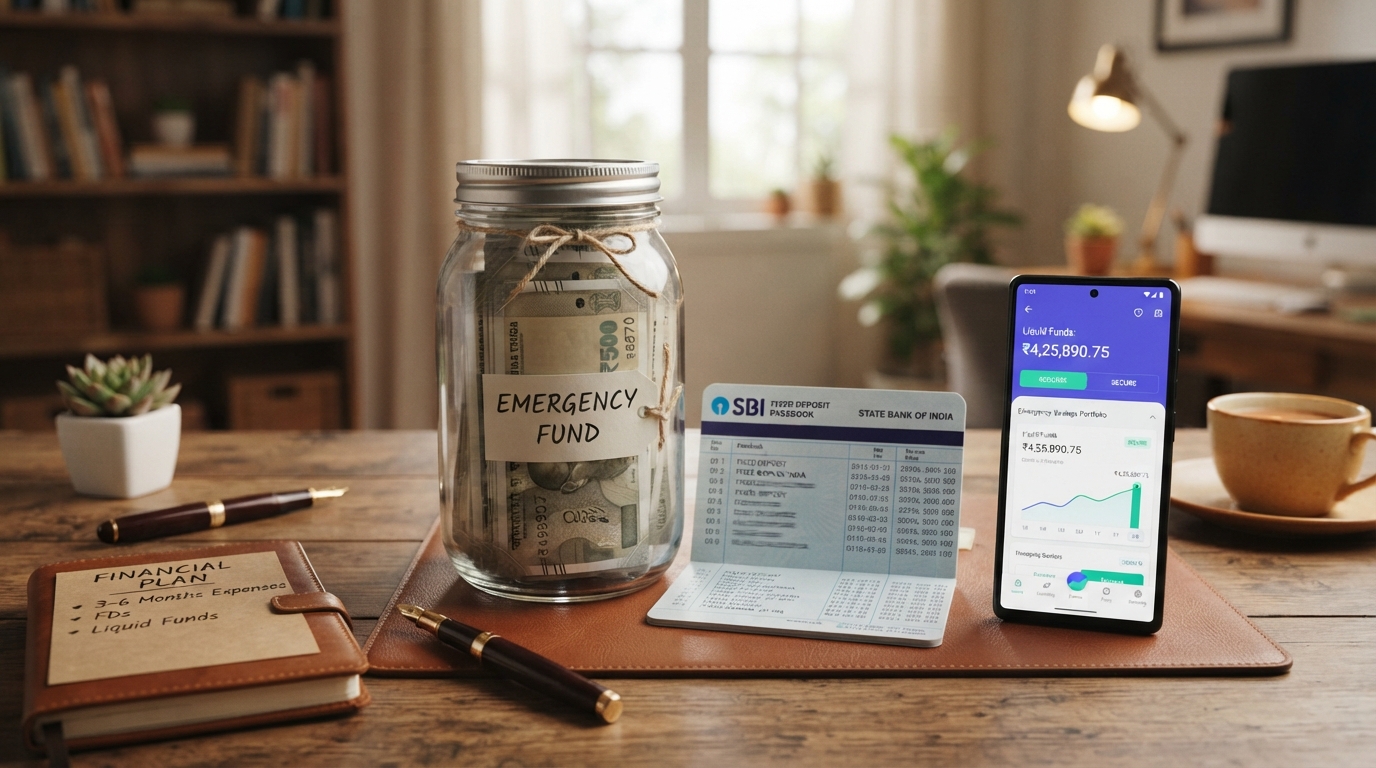
In the euphoria of bull markets and skyrocketing equity mutual fund returns, personal risk management is frequently dismissed as an afterthought by Indian retail investors. Salaried professionals routinely channel every spare rupee into thematic funds, mid-cap stocks, or aggressive pre-EMI real estate commitments, mistakenly assuming that their recurring monthly paycheck is an immutable guarantee.
However, money management is not merely an exercise in optimizing compounding returns; it is fundamentally about survival during adverse life chapters. When unexpected crises strike whether through tech sector restructuring, pink slips, medical complications surpassing corporate group health limits, or business payment defaults a lack of pure liquid solvency can permanently shatter your long-term wealth trajectory.
The Core Axiom of Indian Personal Finance
Your investments build your future wealth, but your emergency reserve defends your existing dignity. Never begin an equity SIP or buy an individual stock until your liquid emergency corpus is fully established and locked in capital-guaranteed instruments.
The Fragility of Modern Salaried Life in India
Over the past decade, the structural nature of Indian white-collar and blue-collar employment has radically shifted. The traditional public-sector expectation of four uninterrupted decades of guaranteed increment and absolute job security has been replaced by rapid corporate restructuring, AI-driven automation, aggressive private performance PIPs (Performance Improvement Plans), and erratic startup hiring freezes.
Simultaneously, household financial liabilities in urban India have escalated to unprecedented heights. First-generation professionals often carry significant non-negotiable monthly cash outflows:
- High-Leverage Home Loan EMIs: In Tier-1 metros such as Bengaluru, Mumbai, Pune, and the NCR, housing loans easily consume 35% to 50% of the household’s post-tax net income.
- Inadequate Health Insurance Cushion: While most white-collar employees rely heavily on employer-sponsored group mediclaim policies (often limited to ₹3 Lakhs to ₹5 Lakhs), severe critical illnesses, robotic surgical interventions, or prolonged ICU hospitalizations for elderly parents easily cross ₹15 Lakhs to ₹20 Lakhs. Most claims also face strict room-rent sub-limits, non-payable consumable deductions, and co-payment clauses.
- Single-Earner Vulnerability: Over 60% of middle-class households across urban and semi-urban India remain single-income dependent. If the primary earning member experiences an abrupt layoff or temporary medical disability, household operational solvency collapses within 30 to 45 days.
- Delayed Receivables for Gig Workers & MSMEs: Self-employed consultants, architects, small vendors, and software freelancers routinely battle 90-to-120-day invoice clearance cycles from corporate clients, necessitating an extended buffer.
The Golden Benchmark: Why the Western 3-Month Rule Fails in India
If you read standard American or Western personal finance literature, the ubiquitous advice is to accumulate three months of living expenses. Applying this template blindly to the Indian macroeconomic environment is a dangerous financial error.
Western economies offer state-backed social security safety nets, subsidized unemployment allowances, and universal healthcare frameworks (such as the NHS in the UK or Medicare/Medicaid structures). In stark contrast, Indian citizens operate without systemic universal unemployment insurance. When an Indian professional loses their job:
- There is zero direct governmental unemployment compensation or monthly stipend to cover rent, utilities, or EMIs.
- Re-employment cycles for mid-to-senior level roles (earning ₹18 LPA to ₹50 LPA) take anywhere from 4 to 8 months, particularly during industry-wide hiring freezes.
- Severance packages offered by Indian companies are heavily contingent on arbitrary internal policies, typically yielding only 30 to 90 days of basic salary, which is immediately taxed under the standard income tax slabs.
"In India, an emergency fund is not merely a rainy day kitty; it is your self-funded social security apparatus. For retail investors navigating an evolving economy, the minimum non-negotiable benchmark is 6 months, extending to 12 months for single earners and business owners."
Calculating Your True Monthly Survival Burn Rate
A catastrophic error made by retail investors is calculating their emergency fund based on their gross monthly salary or, inversely, underestimating it by omitting critical annual obligations. Your emergency fund target is derived strictly from your Essential Survival Outflows (Burn Rate).
Non-Negotiable Living Expenses (Include 100%)
- Shelter: Monthly Apartment Rent and Society Maintenance, or mandatory Home Loan Bank EMIs. Defaulting on rent leads to eviction; defaulting on bank EMIs destroys your CIBIL score and triggers SARFAESI recovery proceedings.
- Utilities & Sustenance: Electricity bills, water charges, piped gas/LPG cylinders, basic home broadband, mobile recharge plans, and essential household groceries.
- Child Education: School tuition fees, quarterly school bus transport charges, and essential books. School administrations do not waive dues during parental career disruptions.
- Insurance Defenses: Pure Term Life Insurance annual premiums and Family Floater Health Insurance premiums. Letting your health policy lapse during unemployment leaves your family utterly vulnerable to sudden medical debt.
- Parental Support & Chronic Medications: Monthly allowances for dependent parents, routine diabetes/cardiac prescriptions, and ongoing diagnostic testing.
- Vehicle EMIs: If personal transportation is essential for mobility or finding employment.
Discretionary Expenses (Strictly Exclude)
During a legitimate life emergency, lifestyle inflators must be ruthlessly trimmed. Do not budget for:
- OTT streaming subscriptions, fine dining, food delivery platforms, and weekend social outings.
- Annual vacation travel funds, luxury clothing, and consumer electronics upgrades.
- Voluntary discretionary investments (ongoing equity SIPs can be temporarily paused via your AMC dashboard without penalty).
Practical Calculation Illustration: Bangalore Salaried Couple
Consider an IT Project Manager in Bangalore earning ₹1,60,000 monthly in-hand post-tax:
- Home Loan EMI: ₹42,000
- Child School Fee amortized monthly: ₹10,000
- Groceries, Milk, Vegetables: ₹18,000
- Utilities, Maintenance, Broadband: ₹7,000
- Dependent Elderly Parents Maintenance: ₹15,000
- Health & Term Insurance monthly pro-rata allocation: ₹4,000
- Total True Monthly Survival Burn Rate: ₹96,000
Target 6-Month Emergency Fund = ₹96,000 × 6 = ₹5,76,000.
Target 9-Month Safety Corpus (Single Earner) = ₹96,000 × 9 = ₹8,64,000.
Customizing Your Multiplier: 6, 9, or 12 Months?
No two Indian households share the same risk profile. The exact duration of your safety runway is determined by your professional stability, health factors, and income diversity:
Tier 1: 6 Months (Dual-Income Salaried Households)
Applicable if both spouses are actively employed in established, diversified sectors (e.g., one in civil service/banking and another in multinational IT). The probability of both earners encountering simultaneous involuntary employment termination is mathematically low. A six-month liquid cushion provides adequate buffer to manage isolated shocks.
Tier 2: 9 Months (Single-Income Salaried Families)
Applicable to families with dependent children and aging parents where only one spouse generates active income. If the earner works in high-volatility ecosystems such as funded venture startups, early-stage consumer tech, or private investment banking, finding an equivalent compensation package often requires six to nine months of rigorous interview cycles.
Tier 3: 12 Months (Freelancers, Doctors, Consultants & Entrepreneurs)
Self-employed professionals, traders, independent legal counsel, chartered accountants, and MSME business owners face revenue volatility, cyclical demand slumps, and prolonged bad debt write-offs. A full 12-month burn reserve ensures that personal home expenses are never held hostage to late-paying enterprise clients or economic downturns.
The Optimal Asset Allocation for an Emergency Fund in India
The primary purpose of an emergency fund is absolute capital safety and immediate liquidity. It is not an instrument designed to beat inflation or generate alpha. Sticking all your funds into a single savings account leaves returns vulnerable to bank-specific hazards, while locking them up in illiquid schemes defeats their entire purpose.
We recommend the tried-and-tested 20-40-40 Strategic Liquidity Architecture:
A. 20% in Instant High-Grade Bank Savings Accounts (Sweep-in Enabled)
Keep 20% of your total target fund in your primary salary bank account (preferably with domestic systemically important banks like SBI, HDFC Bank, or ICICI Bank). Activate the Auto Sweep-in (Multi Option Deposit) facility. This automatically links your savings balance to a short-term Fixed Deposit, generating standard FD interest while maintaining 24/7 instant ATM and UPI withdrawal capability.
B. 40% in Overnight or Liquid Mutual Funds
Deploy 40% across reputable Liquid Mutual Funds managed by institutional AMCs with massive AUMs (exceeding ₹20,000 Crores) that hold sovereign, PSU, and AAA-rated treasury bills with ultra-short residual maturities (under 91 days).
Crucially, top Indian Liquid Funds offer an Instant Redemption Facility (Insta-Cash) of up to 90% of the folio value or ₹50,000 per day per AMC (whichever is lower) credited to your registered bank account within 30 seconds via IMPS, with normal T+1 payout for the remaining balance.
C. 40% in Short-Term Fixed Deposits across Multiple Scheduled Commercial Banks
Park the remaining 40% in short-term bank fixed deposits (e.g., 6 to 12 months with auto-renewal). Do not place this entire sum in one single financial institution. Under the Deposit Insurance and Credit Guarantee Corporation (DICGC) rules, bank deposits—including principal and interest across all branches of a single scheduled commercial bank—are insured only up to a cumulative limit of ₹5 Lakhs per depositor. Splitting your FD corpus between two distinct scheduled banks guarantees 100% statutory safety.
Assets You Must NEVER Treat as an Emergency Fund
- Equity Mutual Funds & Stocks: In a market crash (such as March 2020), your portfolio can plunge 30% to 40%. Being forced to liquidate equities at a market bottom locks in permanent capital destruction.
- Physical Gold & Sovereign Gold Bonds (SGBs): Selling physical jewelry involves making charges deductions and hallmarking haircuts; SGBs have lock-ins and secondary market liquidity discounts.
- Public Provident Fund (PPF) & EPF: PPF carries a strict 15-year tenure with restricted partial withdrawal limits only after the 6th financial year. EPF claims take 10 to 20 business days to clear.
- Real Estate & Land Plots: Completely illiquid, taking months to monetize.
Taxation Realities (FY 2026–2027 Regulatory Landscape)
Investors must account for post-tax yields when parking liquidity. Following landmark amendments introduced via the Finance Act:
- Bank Savings Account Interest: Under Section 80TTA (for individuals under 60 years), savings interest up to ₹10,000 per financial year remains deductible under the Old Tax Regime. In the default New Tax Regime, 80TTA deductions are not available; all savings interest is added to your income and taxed at your applicable slab rate.
- Fixed Deposit Interest: Entirely taxable as “Income from Other Sources” at your prevailing slab rate. Banks deduct TDS at 10% under Section 194A if total annual interest across branches exceeds ₹40,000 (₹50,000 for senior citizens).
- Liquid and Overnight Mutual Funds: Following the withdrawal of indexation benefits for pure debt funds with less than 35% equity exposure, capital gains realized from Liquid Mutual Funds (irrespective of holding period) are treated as Short-Term Capital Gains (STCG) and taxed at the investor’s nominal income tax slab rates.
Rebuilding Protocol: Replenishing Your Reserve After a Crisis
Using your emergency fund for a genuine medical or career emergency is a triumph of planning—it performed the exact defensive function it was designed for. However, operating without a liquid buffer post-crisis is equivalent to driving without a seatbelt. Follow this four-step reconstitution protocol immediately upon regaining financial stability:
- Temporary Equity Pause: Pause all discretionary monthly SIPs in small-cap, mid-cap, and flexi-cap mutual funds for 3 to 6 months. Divert this monthly investment surplus straight into your savings account and liquid fund.
- Direct Windfall Allocation: Channel 100% of upcoming performance bonuses, annual appraisal increments, and tax refunds toward rebuilding your reserve before planning any home upgrades or discretionary vacations.
- Re-establish Bank Sweeps: Ensure your bank auto-sweep parameters are re-engaged once the core balance crosses minimum thresholds.
- Conduct an Annual Cost-of-Living Review: Inflation increases your monthly burn rate. As rent, school fees, and medical premiums rise over time, increase your total emergency fund target by 7% to 10% annually every April.
Frequently Asked Questions (FAQs) for Indian Retail Investors
Can I use my credit card limit as my emergency fund?
No. A credit card is an unsecured line of short-term debt, not an asset. Credit cards carry exorbitant APR financing charges (36% to 48% per annum) and minimum monthly payment traps. If you lose your job, relying on credit cards leads straight into a compound debt spiral.
Should I keep physical cash at home as part of my fund?
Yes, maintaining approximately ₹20,000 to ₹50,000 in crisp physical cash at home is prudent to handle sudden localized internet blackouts, banking server downtimes, or immediate hospital admission deposits where digital UPI or debit terminals may fail.
What if I have a high-interest personal loan? Should I build an emergency fund first or pay off debt?
Build a mini-emergency fund of at least 2 to 3 months of essential expenses first. Without this initial cushion, any minor unexpected shock will force you to borrow even more at loan-shark rates, erasing your debt repayment progress. Once the mini-fund is in place, aggressively pre-pay high-interest debt.
Are Arbitrage Funds better than Liquid Funds for emergency funds?
Arbitrage funds enjoy equity taxation (12.5% on LTCG after ₹1.25 Lakh, 20% STCG). However, they lack the instant 24/7 ₹50,000 withdrawal facility that liquid funds offer, and redemption takes T+2 settlement days. For rapid emergency response, Liquid and Overnight funds remain superior despite slab-rate taxation.
Is money in digital payment wallets counted as emergency capital?
Prepaid wallets (PPIs) carry regulatory transaction caps, do not earn deposit interest, and cannot pay large hospital or housing bills directly. Rely on regulated scheduled commercial banks and SEBI-registered mutual fund AMCs.
Can I pledge my shares or mutual funds (Loan Against Securities) instead?
Loan Against Securities (LAS) is an option for high-net-worth individuals, but during market corrections, falling collateral values can trigger margin calls, forcing you to infuse fresh cash or suffer forced liquidation at distressed valuations.
Can I split the emergency fund between my spouse and myself?
Yes, maintaining dual individual bank accounts and joint operating mandates ("Either or Survivor") is strongly recommended. This ensures complete unhindered access in the event of incapacitation or sudden hospitalization of either partner.
How often should I re-evaluate the size of my emergency reserve?
Conduct a mandatory check once every 12 months, ideally at the start of the financial year in April, or immediately following major life milestones such as childbirth, taking on a new home loan, or changing careers.
Summary Blueprint: Core Rules of Emergency Liquidity
check_circle
Benchmark
6 months for dual-income, 9 months for single-income, 12 months for freelancers and entrepreneurs.
check_circle
True Burn Rate
Base calculations solely on essential survival expenses (Rent, EMIs, Utilities, Food, Insurance, School Fees).
check_circle
Allocation Split
20% in sweep-in savings accounts, 40% in liquid mutual funds with instant redemption, and 40% in multi-bank fixed deposits.
check_circle
Deposit Insurance
Maintain balances under the ₹5 Lakh DICGC threshold across distinct scheduled commercial banks.
check_circle
Non-Negotiable Rule
Never gamble emergency liquidity on equity stocks, crypto, gold, or locked retirement products.