
Introduction: The Two Engines of Wealth Creation
Every enduring investment portfolio in India is built upon two distinct financial contracts: Ownership (Equity) and Lending (Debt). When retail investors leave their hard-earned money idling in low-yielding traditional savings accounts or long-term Fixed Deposits that struggle to outpace consumer inflation, their purchasing power is steadily eroded. Conversely, jumping recklessly into speculative equity schemes without a defensive debt anchor exposes households to severe market shocks during macroeconomic corrections.
Understanding the structural mechanics, historical returns, underlying risk vectors, and contemporary taxation laws governing Equity and Debt Mutual Funds is not an academic exercise it is the bedrock of pragmatic financial independence. Whether your objective is buying a residential property in five years, funding higher education, or securing a dignified retirement corpus, choosing the appropriate allocation between equity and debt determines over ninety percent of your eventual investment success.
What are Equity Mutual Funds?
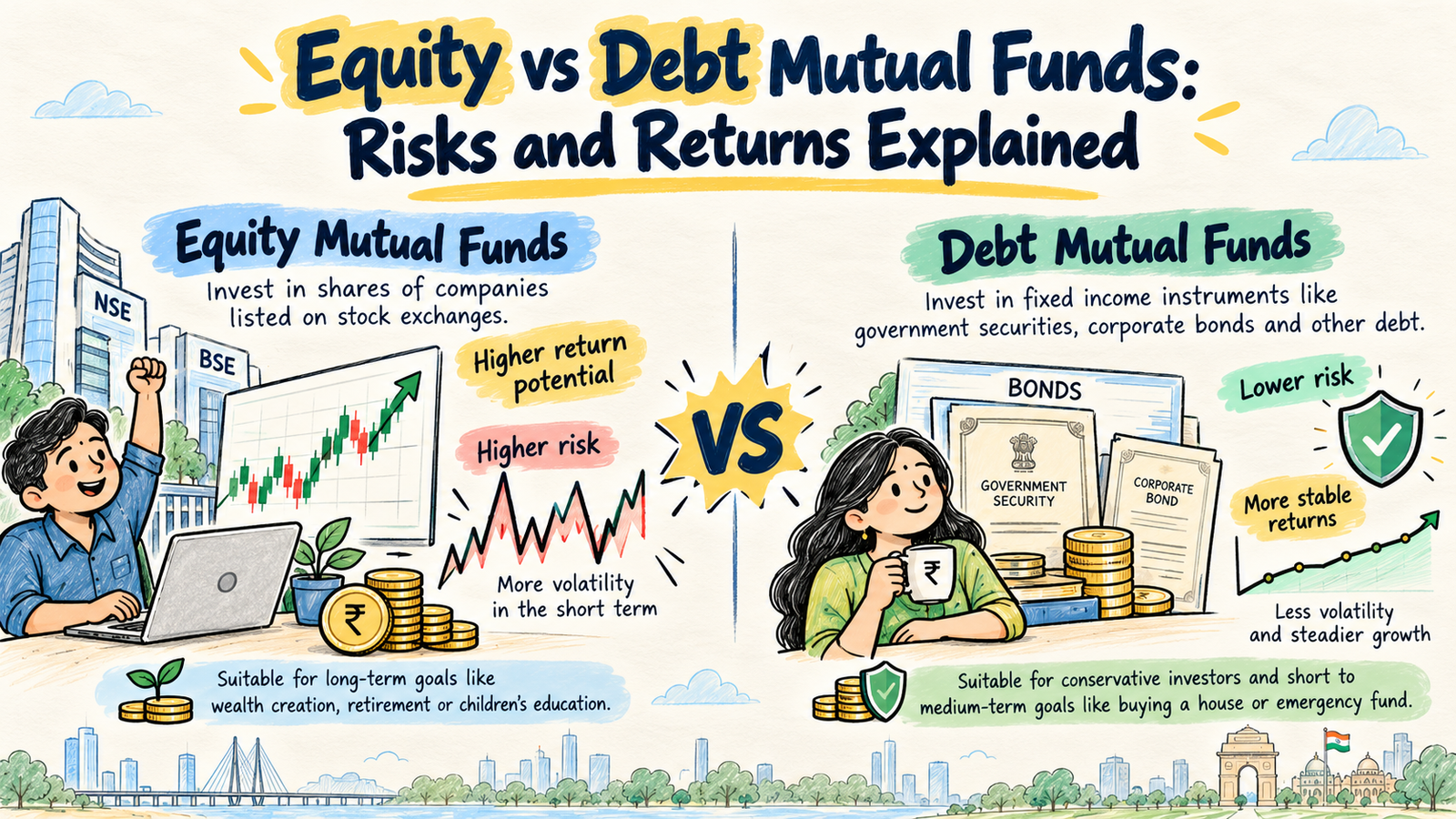
An Equity Mutual Fund is a collective investment vehicle that pools financial capital from hundreds of thousands of retail and institutional investors to purchase equity shares (partial business ownership) of publicly traded companies listed on the National Stock Exchange (NSE) and the Bombay Stock Exchange (BSE).
The Primary Growth Drivers: When you purchase units of an equity fund, you become a proportional shareholder in Indian business enterprises. Your returns are generated through three core drivers:
- Corporate Earnings Expansion: As Indian corporate profitability compounds over time, company valuations rise, increasing the fund’s Net Asset Value (NAV).
- Macroeconomic GDP Growth: India’s structural demographic advantage, urbanization, and formalization of the economy translate into elevated aggregate revenues for organized market leaders.
- Dividend Yields: Regular cash dividends paid by underlying portfolio companies are systematically reinvested into the fund, augmenting compounding velocity.
SEBI Categorization Standards: To protect retail investors from style drift and mandate confusion, the Securities and Exchange Board of India (SEBI) established strict classification guidelines:
- Large Cap Funds: Must invest a minimum of 80% of total assets in the top 100 Indian companies ranked by market capitalization (e.g., Reliance Industries, TCS, HDFC Bank). These firms offer stability and consistent institutional liquidity.
- Mid Cap Funds: Allocate at least 65% in companies ranked from 101 to 250. These are agile, growing enterprises with higher expansion velocity than large caps, balanced by moderate volatility.
- Small Cap Funds: Mandated to deploy at least 65% in companies ranked 251st onwards. While presenting immense compounding potential, small-cap funds experience pronounced drawdown cycles during economic contractions.
- Flexi Cap Funds: A dynamically managed, unconstrained mandate requiring at least 65% in Indian equities across large, mid, and small-cap segments based on fund manager discretion.
- Multi Cap Funds: Strictly mandated by SEBI to maintain at least 25% in Large Caps, 25% in Mid Caps, and 25% in Small Caps at all times, ensuring genuine multi-tier exposure.
- Sectoral & Thematic Funds: Highly concentrated funds allocating at least 80% to a single sector (such as Banking & Financial Services, Technology, or Healthcare) or macroeconomic theme (like Manufacturing or Infrastructure).
- ELSS (Equity Linked Savings Schemes): Diversified equity portfolios that carry a statutory 3-year lock-in period and provide income tax deduction benefits under Section 80C of the Income Tax Act.
What are Debt Mutual Funds?
In contrast to equity funds, a Debt Mutual Fund does not buy corporate ownership. Instead, it operates as an institutional lender. The fund manager deploys investor capital into fixed-income instruments issued by sovereign governments, public sector undertakings, and corporate institutions seeking short-to-medium-term credit.
Core Underlying Debt Securities:
- Government of India Securities (G-Secs): Sovereign sovereign bonds issued directly by the Reserve Bank of India on behalf of the Central Government. Zero sovereign credit default risk.
- Treasury Bills (T-Bills): Short-term sovereign instruments issued for 91, 182, or 364-day tenures at a discount to face value.
- State Development Loans (SDLs): Debt papers issued by individual state governments across India to finance budgetary capital expenditures.
- Corporate Bonds & Non-Convertible Debentures (NCDs): Medium-to-long-term borrowing instruments floated by private and public sector companies, carrying credit ratings ranging from AAA to junk.
- Commercial Papers (CPs) & Certificates of Deposit (CDs): Short-term money market instruments issued by corporates and commercial banks respectively to manage operational liquidity.
How Debt Returns are Generated: Debt funds earn returns through coupon yield (accrual) the contractual interest payments made by borrowers and capital appreciation or depreciation stemming from macro interest rate movements initiated by the RBI Monetary Policy Committee.
Core SEBI Debt Categories:
- Overnight Funds: Invest in overnight securities with a residual maturity of just 1 business day. Negligible credit and interest rate risk; ideal for parking cash for 24–72 hours.
- Liquid Funds: Invest in debt and money market securities with maturity up to 91 days. Ideal for deploying emergency funds and short-term capital parking.
- Ultra Short & Low Duration Funds: Invest in debt papers with Macaulay durations between 3 to 12 months, suitable for horizons between 3 to 9 months.
- Money Market Funds: Invest exclusively in high-liquidity money market instruments with maturities up to 1 year.
- Corporate Bond Funds: Must deploy at least 80% of assets in the highest-rated debt instruments (rated AAA or equivalent).
- Banking & PSU Funds: Mandated to allocate at least 80% in debt papers issued by Banks, Public Financial Institutions, and Public Sector Undertakings.
- Gilt Funds: Minimum 80% investment in Central and State Government securities. Pure sovereign security with zero credit default risk, though subject to significant interest rate volatility during rate change cycles.
Risk Profile Comparison: Equity Volatility vs. Debt Credit & Duration Risk
A common misconception among first-time Indian investors is that debt funds are completely "risk-free" while equity funds are equivalent to "gambling." Both assumptions are flawed. Each asset class carries distinctive, measurable risk profiles that must be evaluated objectively.
Equity Risk Dimensions:
- Market Volatility: Equity markets do not advance linearly. Black swan events, geopolitical conflicts, domestic political transitions, and foreign portfolio investor (FPI) capital outflows can trigger rapid 15% to 35% corrections in headline indices.
- Earnings Contraction: If corporate revenue growth decelerates or input costs spike, company stock multiples undergo severe downward rerating.
- Drawdown Duration: While Indian equities have historically recovered from every historical crisis, recovery cycles can occasionally take 18 to 36 months to reclaim prior peak NAVs.
Debt Risk Dimensions:
- Credit Default Risk: The risk that an issuing corporate entity defaults on its scheduled coupon payments or principal redemption. Indian mutual fund history experienced this vividly during the 2018–2020 liquidity crunch (IL&FS, DHFL, and the subsequent winding up of six yield-oriented debt schemes by Franklin Templeton). Even an abrupt credit rating downgrade from AAA to AA or lower forces instant portfolio NAV markdowns.
- Interest Rate & Duration Risk: Bond prices and interest rates share an inverse relationship. When the RBI hikes the repo rate, existing fixed-rate bonds offering lower coupon rates decline in secondary market value, causing the NAV of medium-to-long duration debt funds to drop. Conversely, when the RBI commences a rate-easing cycle, long-duration Gilt funds generate strong capital gains in addition to regular accrual coupons.
- Reinvestment Risk: The risk that cash flows from maturing high-yield debt papers must be redeployed into newly issued lower-yielding paper during prevailing low-interest-rate environments.
Historical Returns in India: What Can Investors Realistically Expect?
Setting grounded, historically defensible return expectations is paramount to preventing emotional exits during routine market pullbacks.
Equity Mutual Funds (The Compounding Engine):
Over rolling 7 to 10-year holding horizons, diversified Indian broad-market equity mutual funds have historically delivered compound annual growth rates (CAGR) ranging between 12% and 15%. Well-managed mid-cap and small-cap schemes have intermittently outpaced this benchmark over extended cycles. However, over any arbitrary 1-year window, equity returns can fluctuate between -25% and +40%. Hence, equity capital must strictly be reserved for investment horizons exceeding 5 to 7 years.
Debt Mutual Funds (The Capital Defense & Liquidity Engine):
Debt mutual funds in India have historically delivered annualized yields hovering between 6.5% and 8.0%, aligning closely with prevailing commercial bank FD rates and the RBI repo rate corridor. Debt funds should never be viewed as vehicles for aggressive wealth creation; their fiduciary function is capital preservation, predictable liquidity, and balancing portfolio volatility when equities experience cyclical turbulence.
The Complete Taxation Guide: Post-Finance Act & Union Budget Overhauls
The taxation landscape for Indian mutual fund investors underwent profound structural changes with the enactment of the Finance Act 2023 and the subsequent Union Budget capital gains revisions. Knowing your exact post-tax net realization is crucial before allocating substantial capital.
A. Equity Mutual Funds Taxation
A mutual fund scheme with at least 65% exposure to listed domestic equity shares is categorized as an Equity Fund:
- Long-Term Capital Gains (LTCG): If units are redeemed after a holding period of more than 12 months, the realized gains are classified as LTCG. Aggregate long-term capital gains across equity assets up to ₹1.25 Lakh per financial year are 100% tax-exempt. Gains surpassing ₹1.25 Lakh in a financial year are taxed at 12.5% without indexation benefits.
- Short-Term Capital Gains (STCG): If units are redeemed after a holding period of 12 months or less, the entire realized gain is taxed at a flat rate of 20% (plus applicable surcharge and 4% cess).
B. Debt Mutual Funds Taxation (The 2023 Parity Amendment)
For debt mutual funds where domestic equity allocation does not exceed 35%, the historical indexation benefit (adjusting purchase price for inflation via the Cost Inflation Index) has been officially abolished.
- Taxed at Investor Slab Rate: All capital gains realized on debt mutual fund investments are treated as short-term capital gains, irrespective of whether you hold the units for 3 weeks or 7 years. The realized gains are added directly to your total taxable income and taxed according to your applicable personal income tax bracket (up to 30% plus surcharge and cess).
C. The Smart Arbitrage: Why High-Tax Investors Pivot to Arbitrage Funds
Because traditional debt funds are now taxed at maximum slab rates, affluent investors in the 30% tax bracket often utilize Arbitrage Funds as a low-risk alternative. Arbitrage funds generate returns by simultaneously buying equities in the cash market and selling them in the futures market, capturing the mispriced spread with virtually no directional equity risk.
Crucially, because their gross equity exposure exceeds 65%, Arbitrage Funds are legally classified and taxed as Equity Schemes (12.5% LTCG after 12 months, and 20% STCG below 12 months). For someone paying 30% or 39% slab taxes, holding an Arbitrage Fund for 13 months results in substantially higher net post-tax returns than a corporate bond fund.
How to Craft Your Optimal Asset Allocation
Traditional personal finance dogmas often cite simplistic formulas like the "100 minus your age" rule to dictate your equity proportion. In modern institutional financial planning, however, asset allocation is anchored directly to Goal Horizons and Cash Flow Certainty:
Horizon 1: Short-Term Needs (Under 3 Years)
Target Mandate: 100% Debt, Liquid, or Arbitrage Funds. Zero direct equity exposure. Capital preservation and instant liquidity are paramount. Market fluctuations should never endanger capital earmarked for an upcoming home down payment, emergency buffer, or annual tuition fee.
Horizon 2: Medium-Term Goals (3 to 5 Years)
Target Mandate: 30% Equity + 70% Debt / High-Quality Corporate Bond Funds. Or utilize conservative hybrid fund structures. This maintains inflation-beating capability while insulating the core corpus against protracted bear market cycles.
Horizon 3: Long-Term Horizons (7 to 10+ Years)
Target Mandate: 70%–80% Diversified Equity Funds + 20%–30% Sovereign Debt (G-Sec/Gilt) & Sovereign Gold. Maximizes long-term Indian corporate compounding while reserving enough debt capital for annual portfolio rebalancing whenever market valuations hit frothy extremes.
Frequently Asked Questions (FAQ) for Indian Investors
Are Debt Mutual Funds safer than Bank Fixed Deposits?
No. Commercial bank deposits up to ₹5,00,000 per depositor per scheduled bank are legally guaranteed under the DICGC (a wholly-owned subsidiary of the RBI). Debt mutual funds do not carry any statutory capital guarantee. While high-grade debt funds (such as Sovereign G-Sec or AAA Corporate Bond funds) maintain exceptional safety standards, their NAVs fluctuate with daily interest rates and corporate credit conditions.
Can I transfer money directly from an Equity Fund to a Debt Fund without paying tax?
No. In the eyes of the Indian Income Tax Department, a Systematic Transfer Plan (STP) or switch between two mutual fund schemes even within the same Asset Management Company (AMC) is legally classified as a sale (redemption) of the source fund followed by a fresh purchase in the target fund. Applicable capital gains tax will be triggered on the redeemed units.
What happens to a Debt Fund if one of its portfolio companies defaults?
Under SEBI regulations, when a credit event occurs, the fund house must immediately mark down the value of the defaulted security in the portfolio NAV (frequently to zero). SEBI also permits "side-pocketing" (segregated portfolio creation), isolating bad debt papers from the main liquid portfolio so that legitimate existing investors can exit the unaffected assets without panic redemption penalties.
Which is better for an emergency fund: Liquid Mutual Fund or Savings Account?
A combination of both is ideal. Keep 1 to 2 months of immediate operational expenses in a premier scheduled commercial bank account. Park the remaining 4 to 5 months in a top-tier Liquid Fund or Overnight Fund that invests purely in sovereign T-Bills and Tri-Party Repos (TREPS), delivering superior yield efficiency with T+1 business day withdrawal convenience.
What is the optimal frequency to rebalance between Equity and Debt?
A disciplined calendar review once every 12 months is standard practice for retail investors. Alternatively, you can use a tolerance band approach: rebalance only when market run-ups or corrections shift your target allocation by more than 5% (e.g., your 70% equity holding crosses 75% or plunges below 65%).
Do Debt Funds provide monthly dividends that I can rely on for retirement?
Mutual funds offer an IDCW (Income Distribution cum Capital Withdrawal) option, but payout dates and amounts are neither fixed nor guaranteed by law. Instead of relying on unpredictable IDCW declarations, retirees should hold debt units in the Growth option and establish a Systematic Withdrawal Plan (SWP) for customized, tax-conscious monthly cash flow.
Can Non-Resident Indians (NRIs) invest in Indian Equity and Debt Mutual Funds?
Yes, NRIs can invest seamlessly via their Non-Resident External (NRE) or Non-Resident Ordinary (NRO) bank accounts, provided their KYC compliance is certified under FEMA guidelines. Tax deducted at source (TDS) applies to NRI redemptions at the maximum prevailing capital gains tax rates.
Why did the government remove the indexation benefit on Debt Funds?
The Union Government introduced the amendment under the Finance Act 2023 to establish tax parity between traditional bank fixed deposits and market-linked debt mutual funds, closing a longstanding tax arbitrage where high-net-worth investors were paying significantly lower effective taxes on debt fund gains than regular bank FD depositors.
Key Investment Takeaways
check_circle
Equities Build Purchasing Power
Equity funds are indispensable for compounding wealth and outperforming domestic inflation, but demand minimum holding periods of 5 to 7 years.
check_circle
Debt Funds Provide Armor
Debt funds manage short-term liquidity, protect capital, and offer rebalancing reserves during stock market drawdowns.
check_circle
Tax Awareness is Vital
Following Finance Act revisions, debt funds are taxed at individual income tax slab rates, whereas equity mutual funds enjoy 12.5% LTCG rates after ₹1.25 Lakh annual exemption.
check_circle
Consistency Beats Timing
Structure your asset allocation around your personal financial horizons rather than short-term macroeconomic predictions or market commentary.
SEBI Investor Education Notice
Mutual fund investments are subject to market risks; please read all scheme-related offer documents thoroughly before investing. This publication is prepared exclusively for general financial literacy and investor awareness under SEBI Investor Education initiatives. It does not constitute specific investment advice, portfolio recommendation, or taxation counsel.