
The Most Pervasive Myth on Dalal Street
Many first-time mutual fund investors in India assume that a fund with a Net Asset Value (NAV) of ₹10 is cheaper than one with an NAV of ₹500 or ₹1,000. However, unlike individual stock prices, a lower mutual fund NAV does not automatically mean the fund is undervalued or offers better investment potential.
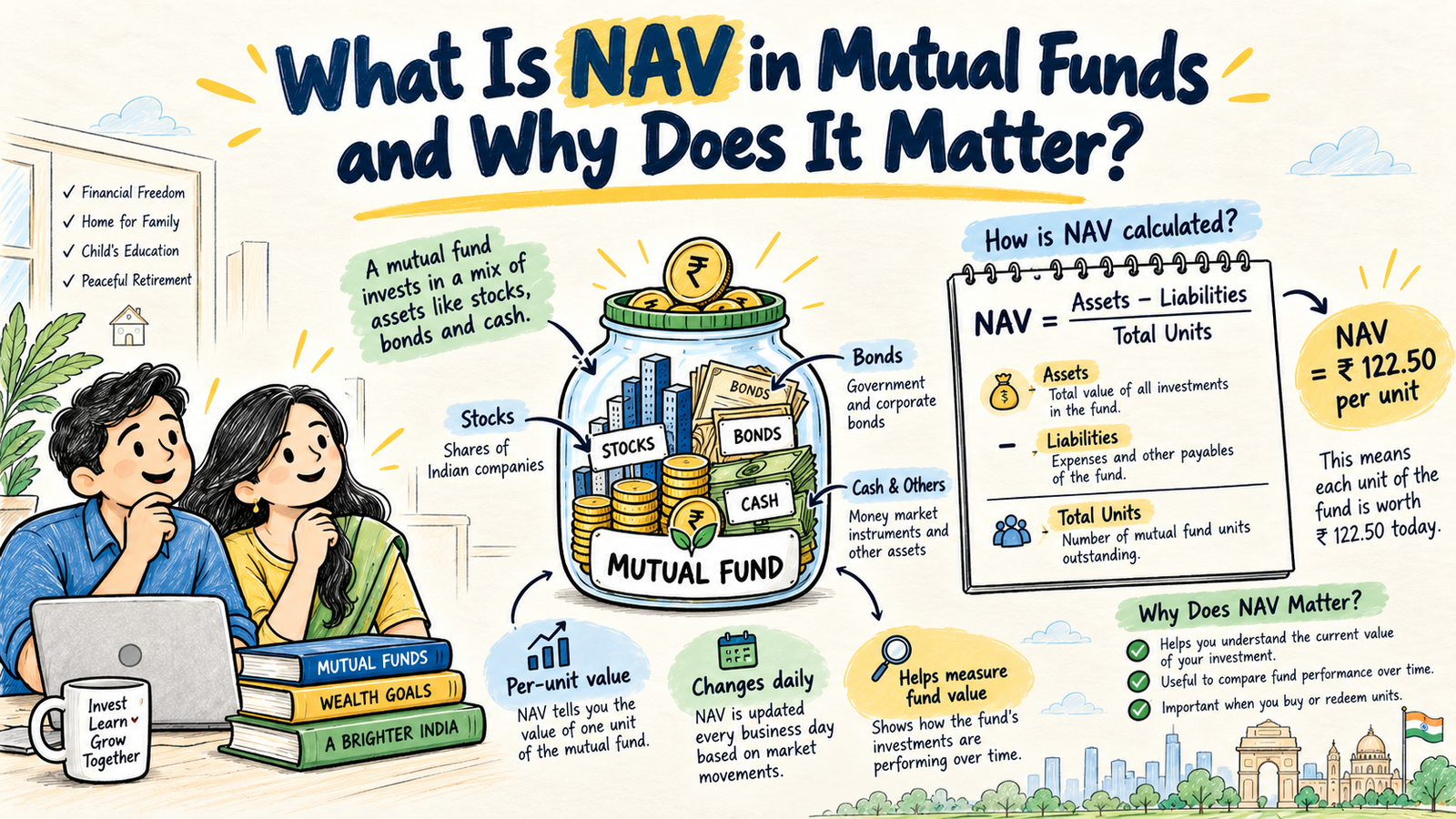
NAV represents the per-unit value of a mutual fund scheme's net assets. It helps determine how many units you receive when investing and the value of your existing mutual fund holdings.
For example, investing ₹10,000 in a fund with an NAV of ₹10 gives you 1,000 units, while the same investment in a fund with an NAV of ₹100 gives you 100 units. If both funds subsequently earn the same percentage return, the investment values will grow by the same percentage.
This guide explains what NAV means, how it is calculated in India, why low NAV does not necessarily mean better value, how applicable NAV cut-off timings work and what investors should consider when comparing mutual funds.
lightbulb
The Dalal Street Reality Check
Unlike corporate shares, a lower Mutual Fund NAV does not mean the investment is cheap, undervalued, or possessing greater upside potential. Units in a mutual fund represent a fractional slice of an actively held investment basket, not a company’s standalone market price. Holding 10,000 units of a scheme or 100 units of another makes absolutely zero mathematical difference to your wealth growth if their underlying portfolios perform identically.
In this comprehensive guide, we unpack the exact mechanics of Net Asset Value (NAV), demonstrate mathematically why unit counts are an optical illusion, examine SEBI's strict cut-off timing guidelines, and reveal the actual institutional metrics you should evaluate before allocating your hard-earned capital.
What Exactly is Net Asset Value (NAV)?
Net Asset Value (NAV) is the per-unit value of a mutual fund scheme's net assets. It is calculated using the value of the scheme's investments and other assets, less its liabilities, divided by the number of outstanding units.
Unlike the continuously changing market price of an individual listed share, the NAV of a conventional open-ended mutual fund is generally calculated and published for each business day using the applicable valuation rules.
NAV reflects the value of the underlying investment portfolio, including unrealised gains and losses, after accounting for relevant liabilities and accrued expenses.
NAV Formula
NAV = (Total Scheme Assets − Total Scheme Liabilities) ÷ Total Outstanding Units
For example, if a mutual fund has total assets worth ₹105 crore, liabilities of ₹5 crore and 10 crore outstanding units:
NAV = (₹105 crore − ₹5 crore) ÷ 10 crore units = ₹10 per unit
This means each unit represents ₹10 of the scheme's net assets. The NAV may increase or decrease as the underlying investments change in value.
NAV determines how many mutual fund units are allotted when you invest, whether through a one-time purchase or regular contributions. Our comparison of SIP vs Lump Sum Investment explains how investment timing can affect the number of units purchased and overall investment outcomes.
SEBI Statutory Valuation Formula
These may include shares, bonds, government securities, cash, receivables and other assets held by the mutual fund, valued according to applicable rules.
These include relevant outstanding obligations and accrued expenses. Ongoing fund expenses are reflected in the scheme's NAV and should not be deducted again as though they were separate unpaid charges.
This is the total number of mutual fund units issued and remaining outstanding on the valuation date.
A fund's NAV is the result of dividing its net assets by its outstanding units. A higher or lower NAV does not, by itself, establish whether the fund is attractively valued or suitable for an investor.
Because the NAV is strictly a division problem, it carries no premium, no speculative markup, and no discount. An investor holding a fund with a NAV of ₹10 owns ₹10 worth of underlying market assets per unit. An investor holding a fund with a NAV of ₹1,000 owns precisely ₹1,000 worth of underlying market assets per unit. Neither is cheaper or more expensive.
For an official explanation of NAV calculation and its role in mutual fund investing, refer to AMFI’s Net Asset Value guide.
Does a Lower NAV Mean a Better Mutual Fund?
No. A lower Net Asset Value (NAV) does not automatically make a mutual fund cheaper or more attractive.
Suppose you invest ₹10,000 in two different mutual funds:
- Fund A has an NAV of ₹10, giving you 1,000 units.
- Fund B has an NAV of ₹100, giving you 100 units.
If both funds earn a hypothetical 10% return, both investments become worth ₹11,000.
This demonstrates that investment growth depends on percentage returns rather than the number of units purchased.
When comparing mutual funds, investors should focus on investment objectives, portfolio quality, expenses, risk and performance against a relevant benchmark rather than selecting a scheme based on NAV alone.
Debunking Myth #1: 'A Lower NAV Means the Mutual Fund is Cheaper'
This is the single most persistent cognitive bias among retail investors across India. In equity trading, a stock trading at a Price-to-Earnings (P/E) multiple of 12x might be considered fundamentally cheaper than a peer trading at 75x. In real estate, an apartment at ₹4,000 per sq. ft. is undeniably cheaper than one at ₹25,000 per sq. ft. in the same district.
Applying this mental model to mutual funds is fundamentally flawed because mutual fund units are simply measurement containers. Let us illustrate this with an undeniable mathematical demonstration.
The Controlled Experiment: Scheme A (₹10 NAV) vs. Scheme B (₹1,000 NAV)
Suppose two investors, Aman and Priya, each have an identical capital of ₹1,00,000 to invest on the same morning. Both choose diversified large-cap funds with the exact same investment philosophy and mirror portfolio holdings.
Starting NAV: ₹10.00
Units Allocated: ₹1,00,000 ÷ ₹10 = 10,000 Units
Aman feels satisfied holding a vast quantity of units.
Starting NAV: ₹1,000.00
Units Allocated: ₹1,00,000 ÷ ₹1,000 = 100 Units
Priya receives just 100 units on her CAS statement.
What happens after 1 Year if both portfolios grow by 15%?
• Scheme A's NAV expands by 15% from ₹10.00 to ₹11.50. Aman’s total portfolio value = 10,000 units × ₹11.50 = ₹1,15,000.
• Scheme B's NAV expands by 15% from ₹1,000.00 to ₹1,150.00. Priya’s total portfolio value = 100 units × ₹1,150 = ₹1,15,000.
Result: Both investors earn the same hypothetical return of 15%, increasing their investment from ₹1,00,000 to ₹1,15,000.
This example demonstrates why the number of mutual fund units and the starting NAV do not determine investment performance. Actual returns depend on the underlying portfolio, fund expenses and market conditions.
Think of it like buying gold. If you walk into a jeweler with ₹1,00,000 to buy 24-karat gold, you can ask for one solid 15-gram biscuit or fifteen individual 1-gram coins. If the spot price of gold appreciates by 20%, does the person with fifteen 1-gram coins gain more money than the person with the single 15-gram bar? Obviously not. Unit count in mutual funds is merely how finely the gold biscuit has been sliced.
For further clarification on common misconceptions about mutual fund investing, read AMFI’s Mutual Fund Myths and Facts.
Debunking Myth #2: 'NFOs at ₹10 are Like IPOs at Par Value'
A New Fund Offer (NFO) is the initial subscription period during which a mutual fund scheme offers units to investors. Many NFOs have an initial face value of ₹10 per unit, but this does not mean the investment is discounted or cheaper than an established fund.
An NFO differs from a company's Initial Public Offering (IPO). In an IPO, investors purchase shares representing ownership in a company. In an NFO, investors purchase units representing an interest in a mutual fund scheme's investment portfolio.
Important Differences Between NFOs and Existing Funds
- Initial NAV Is Not a Discount: A ₹10 NFO unit does not provide a valuation advantage over an existing mutual fund with a higher NAV.
- Limited Scheme Track Record: A newly launched scheme generally does not have its own historical performance record. Investors can examine the investment objective, benchmark, portfolio strategy, fund manager information and AMC disclosures.
- Deployment of Investments: After collecting subscriptions, the fund invests according to its stated mandate and applicable deployment rules. Investment timing and cash holdings may affect early performance.
- Different NFO Structures: Open-ended mutual funds generally transact at applicable NAV after reopening for ongoing subscriptions and redemptions. Certain ETFs and closed-ended schemes may also trade on exchanges, where market prices can differ from NAV.
Investors should evaluate an NFO's investment objective, risks, costs and suitability rather than selecting it solely because its initial NAV is ₹10.
Debunking Myth #3: 'High NAV Funds Have Less Room to Grow'
A mutual fund with an NAV of ₹1,000 does not necessarily have less growth potential than a fund with an NAV of ₹20.
For example, if a fund with an NAV of ₹1,000 earns a return of 10%, its NAV would increase to ₹1,100. If another fund with an NAV of ₹20 earns the same 10% return, its NAV would increase to ₹22.
Both investments generate the same percentage return, assuming other factors are comparable.
A higher NAV may reflect accumulated investment growth over time, but it can also be influenced by the scheme's NAV history, distributions and other structural factors. NAV alone does not reliably indicate the age, quality or future performance of a mutual fund.
Investors should compare fund objectives, relevant benchmark returns, risk, costs and portfolio characteristics rather than choosing a scheme based on its NAV level.
How and When Is Mutual Fund NAV Calculated in India?
Mutual funds in India operate under SEBI's regulatory framework. For conventional open-ended schemes, NAV is generally calculated for each applicable business day using the valuation of the scheme's assets and liabilities.
The mutual fund values its holdings, such as listed shares, bonds, government securities and other permitted investments, using the applicable valuation policies and regulatory requirements.
The scheme accounts for cash, accrued income, receivables, liabilities and relevant operating expenses.
The scheme's net assets are divided by its outstanding units to determine the NAV.
The Asset Management Company (AMC) publishes the applicable NAV through its official channels and AMFI according to the relevant disclosure requirements.
Most conventional mutual fund NAVs are calculated after the market closes rather than fluctuating continuously during market hours. Different valuation and transaction rules may apply to liquid funds, overnight funds, ETFs and certain other schemes.
Investors can check published NAVs through AMFI's official NAV information portal.
Investors can check the latest published mutual fund NAVs through AMFI’s official NAV portal.
SEBI Cut-Off Timing & NAV Realization Rules (Updated Guidelines)
When an investor initiates a lump-sum investment or an SIP executes through an automated mandate (UPI, Net Banking, NACH/e-Mandate), what day’s NAV do they actually receive? SEBI has tightened these rules considerably to ensure parity between small retail unitholders and high-net-worth institutional treasuries.
gavel Mutual Fund NAV Cut-Off Timings in India
The NAV applicable to a mutual fund transaction depends on the scheme category, the type of transaction, the time a valid request is received and, for purchases, when the money becomes available to the mutual fund.
For the detailed rules covering purchase requests, fund realisation and applicable NAV dates, refer to AMFI’s official NAV cut-off timing guidance.
Important: Submitting a payment or seeing money debited from your bank account before the cut-off does not automatically guarantee a particular NAV. Check the AMC's applicable transaction and fund-realisation rules.
For the detailed requirements, refer to AMFI’s official NAV cut-off timing guidance.
What Should Investors Compare Instead of a Mutual Fund's NAV?
Now that we have definitively dismissed NAV size as a metric of valuation or performance, where should serious Indian retail investors direct their attention? When evaluating mutual funds, institutional analysts ignore NAV and scrutinize four critical pillars:
A. Investment Objective and Fund Category
Understand whether the scheme invests in large-cap equities, mid-cap equities, bonds, index constituents or another asset category. The investment objective should align with your financial goals and investment horizon.
Different types of mutual funds follow different investment strategies. If you’re comparing passive and active investing, explore our guide on Index Funds vs Mutual Funds to understand their costs, objectives and risks.
B. Historical Performance and Benchmark Comparison
Review returns across suitable periods and compare the scheme against a relevant benchmark and similar funds. Rolling returns can help examine performance across different start dates, but historical results do not guarantee future performance.
C. Risk and Portfolio Diversification
Consider the fund's Riskometer classification, volatility, concentration, credit quality and underlying holdings. Metrics such as Sharpe and Sortino ratios may provide additional context, although no single statistic captures every investment risk.
D. Expense Ratio and Investment Plan
Compare the Total Expense Ratio (TER), investment strategy and Direct versus Regular Plan options. Direct Plans generally have lower expense ratios, but the exact difference varies by scheme.
Fund expenses influence the NAV and long-term investment returns. To understand the differences in costs, read our detailed comparison of Direct vs Regular Mutual Funds.
E. Investment Suitability and Liquidity
Consider whether the fund fits your financial circumstances, investment horizon and need for access to money. Review exit loads, lock-in requirements and other restrictions before investing.
A lower NAV is not a reliable shortcut for identifying a better mutual fund. Investors should assess the scheme as a whole rather than focusing on the numerical price of one unit.
Before choosing a mutual fund, investors should also understand its investment objective, risk profile and key features. Refer to SEBI’s mutual fund investor education guide for additional information.
Frequently Asked Questions (8 Practical Answers)
Does a dividend payout (IDCW) reduce the NAV of a mutual fund?
Yes. When a mutual fund declares an Income Distribution cum Capital Withdrawal (IDCW), its NAV generally decreases by the amount distributed per unit, subject to other changes in the value of the scheme's assets.
For example, if a fund has an NAV of ₹100 and declares an IDCW of ₹5 per unit, its NAV would generally adjust to approximately ₹95, assuming there are no other changes.
Any applicable tax deduction at source (TDS) affects the amount received by the investor; it should not be added again to the NAV reduction. IDCW distributions are not guaranteed and may be taxable in the investor's hands.
Why does a debt fund's NAV fluctuate if it does not invest in equities?
Debt mutual funds invest in instruments such as government securities, corporate bonds and money-market instruments. Their NAVs can fluctuate due to changes in interest rates, credit quality, liquidity and market valuations.
For existing fixed-rate bonds, rising market yields generally reduce prices, while falling yields generally increase them. The extent of the impact depends on the securities and their duration. Debt funds are not risk-free investments.
How do stock splits or corporate actions in portfolio holdings affect NAV?
A conventional stock split generally does not directly change the total value of a mutual fund's holding at the moment of the split. For example, in a 2-for-1 stock split, the number of shares doubles while the theoretical price per share is halved.
However, corporate actions can involve different adjustments, taxes, cash flows and market reactions. Their actual impact on a mutual fund's NAV depends on the type of corporate action and subsequent changes in the value of its investments.
Can a mutual fund NAV ever drop to zero?
Mutual fund NAVs can fall significantly if their underlying investments lose value. Diversification may reduce concentration risk, but it does not eliminate investment losses.
A complete loss of value in a diversified fund is generally an extreme scenario, but investors should not assume that any mutual fund is guaranteed to preserve capital.
The actual risks depend on the scheme's investments, concentration, credit quality and market conditions. Always review the fund's investment objectives and Riskometer classification.
Why is the NAV of Direct plans always higher than Regular plans?
Direct Plans generally have lower expense ratios than Regular Plans of the same scheme because distributor commissions are excluded from Direct Plan expenses.
Over comparable periods, these lower costs can contribute to higher NAV growth. However, the absolute NAV values of two plans should not be used in isolation to assess performance, because starting NAVs, distributions and plan history can differ.
Investors should compare returns over matching periods and the latest disclosed expense ratios.
If I buy a fund on Friday evening, which NAV will I receive?
For most conventional equity mutual funds, a purchase request made after the applicable Friday cut-off will generally be eligible for the NAV of the next applicable business day, often Monday.
However, the result depends on the scheme category, transaction validity, when the funds become available to the mutual fund and market holidays. Liquid and overnight funds follow different NAV rules. Check the AMC's applicable NAV policy rather than assuming that every Friday evening purchase receives Monday's NAV.
Can I track intraday NAV changes like stock tickers?
Conventional open-ended mutual funds generally publish NAV after the applicable valuation process rather than updating it continuously during stock-market trading hours.
Exchange-Traded Funds (ETFs), by contrast, trade on exchanges during market hours and have market prices that can differ from their indicative NAV. An ETF's traded market price should not be confused with the closing NAV of a conventional mutual fund.
Is it true that SIPs smooth out NAV fluctuations?
A Systematic Investment Plan (SIP) invests money at regular intervals. When NAV is lower, a fixed contribution generally purchases more units; when NAV is higher, it purchases fewer units.
This is known as rupee cost averaging. However, an SIP does not smooth the actual NAV of a mutual fund, guarantee a lower average purchase cost in every market or protect investors against losses.
Understanding NAV can also help you see how regular mutual fund investments work. Read our beginner-friendly guide on What Is SIP and How Does It Work in India? to learn about monthly investments, rupee cost averaging and market risks.
Key Takeaways: Understanding Mutual Fund NAV
check_circle
NAV represents per-unit net asset value
It is calculated by dividing a mutual fund scheme's net assets by its outstanding units.
check_circle
Low NAV does not mean cheap
A ₹10 NAV does not automatically provide better value than a ₹1,000 NAV.
check_circle
Higher NAV does not guarantee better performance
NAV alone does not establish a fund's age, quality or future growth potential.
check_circle
Applicable NAV depends on transaction rules
Purchase cut-off timings, valid requests and fund realisation determine the applicable NAV.
check_circle
Expenses affect investment returns
Fund expenses are reflected in NAV, and expense ratios vary by scheme and plan.
check_circle
Evaluate the entire mutual fund
Consider investment objectives, risks, costs, portfolio characteristics and benchmark performance rather than selecting a fund based on NAV alone.
Official Sources and References
This article draws on publicly available information from authoritative Indian mutual fund industry and regulatory sources.
- AMFI – What Is Net Asset Value (NAV)? – NAV meaning, calculation and applicable NAV concepts.
- AMFI – Myths and Facts About Mutual Funds – Common misconceptions about mutual fund investing.
- AMFI – Official Mutual Fund NAV Portal – Published mutual fund NAV data.
- AMFI – Cut-Off Timings and Applicable NAV Rules – Transaction cut-off timings and fund realisation requirements.
- SEBI – Understanding Mutual Funds – Investor education, mutual fund features and investment risks.
Readers should refer to the latest official publications because mutual fund regulations, transaction rules and investment conditions may change.
Investment Risk Disclaimer
This article is intended for general financial education only and does not constitute personalised investment, financial or tax advice.
Mutual fund investments are subject to market risks. Net Asset Value (NAV) can increase or decrease depending on changes in the value of a scheme's underlying investments. A lower NAV does not guarantee better returns, and past performance does not predict future results.
Investors should review the scheme's investment objectives, risk classification, expense ratio and official documents before investing.
Paisa Hai Toh does not claim endorsement or approval from SEBI or AMFI. Readers who require personalised advice should consult an appropriately qualified financial professional.